


The Silent Starvation: A Mother’s Desperate Battle with Severe Gastroparesis
When 36-year-old Emilie Cullum vomited shortly after eating her usual morning bowl of cereal in November 2024, she brushed it off as expired milk. But when the sickness persisted violently over the next ten days—leaving her unable to keep any meals down—she knew the problem was far more severe.
“I ate breakfast and was really sick but didn’t feel ill, didn’t have a temperature or anything like that… then had dinner and was sick again,” the aesthetic clinician from St Albans, Hertfordshire, recalled. “Because I had been so violently sick for days, I thought then I had broken my rib being sick.”
What began as a suspected bout of food poisoning has since unraveled into a devastating, life-threatening medical crisis.

From a Misdiagnosis to a “Broken Stomach”
Initially, after a visit to A&E, Emilie was diagnosed with Crohn’s disease, an incurable inflammatory bowel condition. However, her symptoms did not subside. For three agonizing months, she was plagued by daily sickness, isolating her from family meals and draining her energy.
Desperate for answers, she booked a private consultation with a specialist in February 2025. The true diagnosis was staggering: Gastroparesis.
Gastroparesis is a rare, incurable condition where the stomach cannot empty food properly, causing it to pass through the digestive system at an abnormally slow rate. The specialist informed Emilie that her abdominal pain was the result of severe nerve damage; the nerves responsible for signaling her stomach to empty were failing.
“My stomach is completely broken,” Emilie was told. “Nothing is going through.”

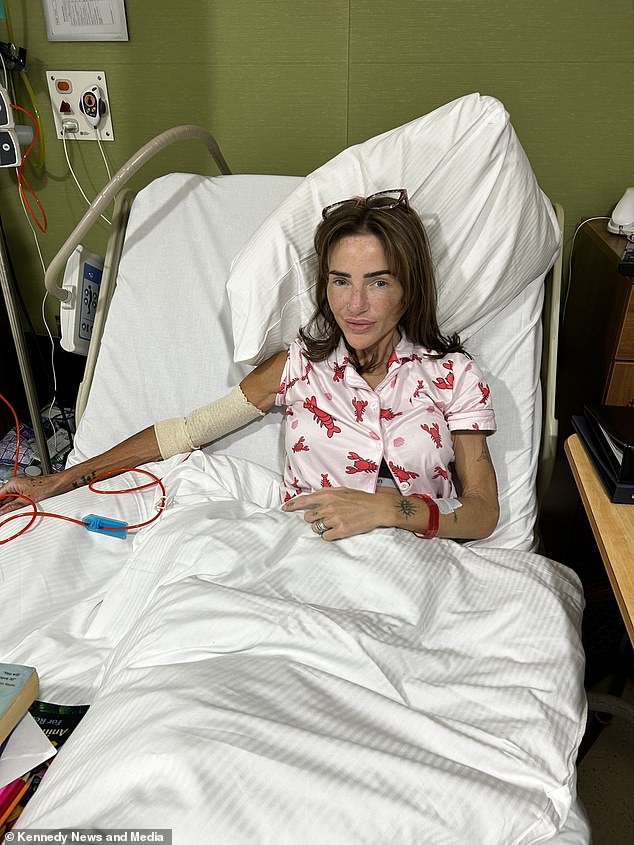
Emilie Cullum (left) vomited after eating a bowl of cereal in November 2024 and has been diagnosed with gastroparesis

Ms Cullum’s weight has almost halved from 8st 5lb to 4st 8lb

A Drastic Decline and a Terrifying Prognosis
While gastroparesis affects roughly 14 in every 100,000 Britons—often causing bloating and premature fullness—Emilie’s case is exceptionally severe. Because she feels full constantly and cannot keep food down, her weight plummeted drastically, halving from a healthy 8st 5lb to a critically low 4st 8lb.
“While I was in hospital they scanned me and they said if I don’t get some weight on me, essentially I’m ‘forced’ anorexic, so I probably haven’t got much longer than a year,” she explained. The prospect of leaving her husband, Kyle, and their three children is a reality she calls “horrific” and “unthinkable.”
The £200,000 Fight for Total Parenteral Nutrition (TPN)
Currently confined to residential hospital care, Emilie has managed to increase her weight slightly to just over 5st. She recently underwent a jejunostomy, a surgical procedure that allows feeding directly into the small intestine via a tube, and receives fluids and medications intravenously through Hickman and PICC lines.
However, her ultimate survival relies on qualifying for Total Parenteral Nutrition (TPN)—a treatment that delivers essential nutrients directly into the bloodstream.
To qualify for TPN on the NHS, she must reach a target weight of 6st 9lb. In the meantime, her extended hospital stays are robbing her of precious time with her family. To bring her home, her friends have launched a GoFundMe campaign to raise £200,000 for private, at-home TPN treatment and nursing care.
“She can come home with a private nurse meaning she gets to be with her family, most importantly her young children as they struggle through their GCSEs because their mother is starving to death,” the fundraiser states.
“I don’t want to go into hospital knowing that I don’t have that much time left and not spending it with my family,” Emilie shared. “This is my last hope to be around for as long as possible.”
🩺 Medical Fact File: Understanding Gastroparesis
Gastroparesis literally translates to “stomach paralysis.” It affects the normal movements of the stomach muscles, preventing the organ from emptying properly.
| Key Aspects of Gastroparesis | Details |
| Primary Causes | Often caused by damage to the vagus nerve, which controls stomach muscles. Can occur as a complication of diabetes, post-surgery, viral infections, or from certain medications (like specific antidepressants or pain relievers). |
| Common Symptoms |
• Severe nausea and vomiting • Feeling full after only a few bites • Acid reflux and abdominal bloating • Unintentional weight loss and lack of appetite |
| Severe Complications | Severe dehydration, chronic malnutrition, wild blood-sugar fluctuations, and the formation of bezoars (undigested food hardening in the stomach, which can be life-threatening). |
| Treatment Options | There is no cure. Treatment focuses on dietary shifts (smaller, frequent, well-chewed meals), anti-nausea medications, and in severe cases, surgically implanted feeding tubes or intravenous nutrition (TPN). |
