


There was no pain or discomfort – nothing that felt urgent enough to demand attention.
Instead, it was a kind of quiet draining away – a heaviness that settled into Kerry Hatrill’s limbs and refused to lift.
By mid-afternoon, she found herself flagging, pushing through a fog of fatigue she couldn’t quite explain. She told herself it was life catching up with her. At 49, juggling work and family, this was what getting older looked like, wasn’t it?
When the bloating started, and her energy dipped further, the explanation seemed to slot neatly into place: menopause.
The slow, inevitable hormonal shift into a new phase of life that every woman can expect in midlife. Friends spoke about it, articles described it – the exhaustion, the changes, the sense of not quite feeling like yourself.
So Kerry carried on.
The tiredness deepened, but it was easy to rationalise. A bad night’s sleep. A stressful week. Too much on her plate.
Even the subtle changes in her body – things she might once have questioned – were folded into that same reassuring narrative: this is normal, this is age, this is just what happens.

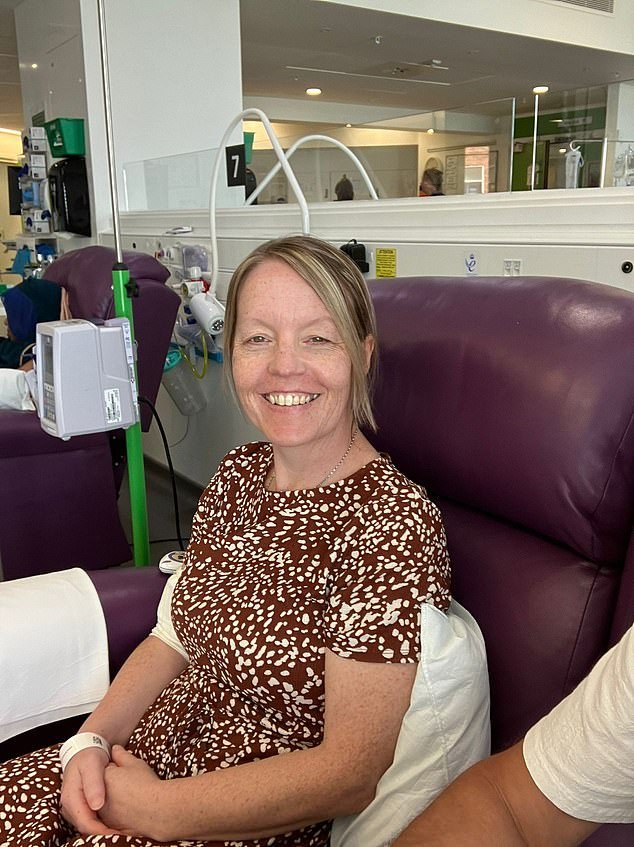
Like many women approaching 50, Kerry Hatrill blamed her growing list of symptoms – fatigue, bloating and changes in her bowel habits – on perimenopause

Kerry, pictured ringing the ‘end of treatment’ bell at hospital, was diagnosed with stage three rectal cancer
By the time more obvious symptoms began to emerge, Kerry had already spent weeks learning how to explain them away.
When she noticed faint pink streaks after going to the toilet, she assumed it was nothing serious. The mother-of-two put it down to something she had eaten – or simply another indignity of getting older.
But over the following weeks, the symptoms began to stack up. Kerry, a customer service assistant from Bromley, developed persistent bloating, worsening fatigue and subtle but definite changes in her bowel habits.
Her GP initially reassured her after a stool test came back normal. Yet the unease lingered.
Soon, there was a growing urgency to use the toilet, paired with a frustrating sensation of needing to go but being unable to.
‘My stools became pencil thin, and I often felt the urge to go but couldn’t,’ she says.
She also began experiencing occasional sharp rectal pain – alongside the same unrelenting fatigue that had first crept in weeks earlier.
It was only after a significant episode of bleeding in April 2024 that she returned to her doctor. This time, further tests revealed low iron anaemia – a red flag that prompted an urgent referral for a colonoscopy.
During the procedure, which involves a camera being inserted into the back passage, doctors discovered a large tumour in her rectum – roughly the size of a small orange.
A month later, Kerry was diagnosed with stage three rectal cancer.
‘I’d already been given an indication it could be cancer, so when I received the official diagnosis, I felt prepared,’ she says. ‘I was calm and ready with questions.’
Bowel cancer is diagnosed in around 45,000 people and is responsible for around 17,700 deaths in Britain every year. This makes it the second-most common cause of cancer death.

Kerry, a customer service assistant from Bromley, developed persistent bloating, worsening fatigue and subtle but definite changes in her bowel habits

‘Telling my kids was incredibly hard because I couldn’t guarantee what the outcome would be,’ she says of her sons, Jake, 28, and Craig, 25
In the United States, approximately 158,850 people are expected to be diagnosed with colorectal cancer this year – and just over 55,000 will die from it.
While it has long been associated with older age, cases among younger adults have been rising.
Today, 45 per cent of diagnoses are in under-65s – a significant jump from 27 per cent in 1995. One in five diagnoses now occur in people under 55. At present, everyone in Britain is offered a home screening test every two years from the age of 50.
In America testing in recommended from age 45, and also includes a colonoscopy – which is considered the gold standard visual exam.
During the procedure, precancerous polyps, if spotted, can be removed. Typically, this is performed every 10 years if results are normal.
While still relatively uncommon in younger groups, around 2,500 Britons and 12,500 Americans under 50 are now diagnosed each year – and numbers are rising.
While diagnoses in older adults are falling, rates in younger people have been increasing in recent years – a trend that has both mystified and concerned doctors.
According to Cancer Research UK, diet is a key area of concern. Evidence suggests eating too much red and processed meat increases the risk of bowel cancer, alongside eating too little fibre.
Adults are recommended to get 30g of fibre a day – but around 96 per cent fail to meet this target.
Not getting enough calcium – found in foods such as milk and yoghurt – may also play a role. One recent study found that an additional 300mg of calcium a day, roughly the amount in a glass of milk, could significantly lower bowel cancer risk.
Being overweight, physically inactive and smoking are also known to increase the risk.
If caught early, the disease is highly treatable – around 90 per cent of patients diagnosed at stage one are cured. But once the cancer has spread – known as stage four – survival drops sharply, with only around one in ten patients living for five years or more.
Although initially frightened during the colonoscopy, by the time her diagnosis was confirmed, Kerry says she did not see it as a death sentence.
‘They said it was treatable and that gave me a sense of relief,’ she says. ‘I simply wanted the cancer removed and to be cured.’
She underwent an intensive course of treatment, beginning with four rounds of chemotherapy, followed by 25 sessions of radiotherapy alongside chemotherapy tablets.
In February last year, she had major surgery to remove the tumour.
‘Telling my kids was incredibly hard because I couldn’t guarantee what the outcome would be,’ she says of her sons, Jake, 28, and Craig, 25.
Despite the uncertainty, she says their support carried her through.
Throughout treatment, Kerry experienced nausea, weakness, joint pain and extreme fatigue – and has since been left with long-term peripheral neuropathy affecting her fingers and toes.
The condition, which can cause tingling, burning or stabbing pain, numbness and muscle weakness, is a known side effect of some chemotherapy drugs.
She continued working throughout, supported by her employer.
Then, just one month after completing her final round of chemotherapy, came the news she had been hoping for.
‘When I was told, I felt elated,’ she says. ‘Everything I had been through felt worth it.’
Despite extensive publicity around the spike in bowel cancer cases among under-50s, thousands of young women are still being diagnosed with the disease too late, when it is no longer curable.
This is because early signs of the disease, such as fatigue, changes in bowel habits and blood in the stool, often overlap with much more common symptoms associated with hormonal changes after birth or in mid-life.
As a result, key red flags for the deadly disease can be dismissed as simply ‘women’s issues’ by GPs and patients.
This was the case for Married At First Sight star Mel Schilling, who passed away last month, aged 54, from bowel cancer that had spread to her brain.
The psychologist-turned-relationship guru had put off seeing a doctor because she believed the symptoms – including abdominal pain, constipation and fatigue – were due to the menopause.
The same was true for bowel cancer campaigner Dame Deborah James, who died in 2022. She put her change in bowel habits down to the stress of being a ‘super mum’ working full-time.
For a year she ignored her increasingly severe symptoms – losing weight, passing blood and needing the loo ‘what felt like 100 times a day’ – before finally having a colonoscopy.
For younger women like these, says Genevieve Edwards, chief executive of charity Bowel Cancer UK, keeping an eye out for the signs of bowel cancer is low on their priorities.
‘If a woman is experiencing concerning symptoms, it’s understandable that she and her GP might explore other avenues first,’ she said.
‘Because bowel cancer, though rising, is still rare in that age group, they often end up going back to their GP time and again while other causes are ruled out.
‘But by that point, you may end up with a cancer that is much harder to treat.’
Now on a five–year monitoring plan, Kerry is sharing her story to raise awareness of the symptoms she initially dismissed.
‘I want to encourage others not to ignore symptoms,’ she says.
‘If you notice changes in your bowel habits lasting more than three weeks, blood when you wipe, bloating or extreme fatigue, please seek medical advice.
‘You’re never too young – and if something doesn’t feel right, keep pushing for answers. Early detection can make a life–changing difference.’
