

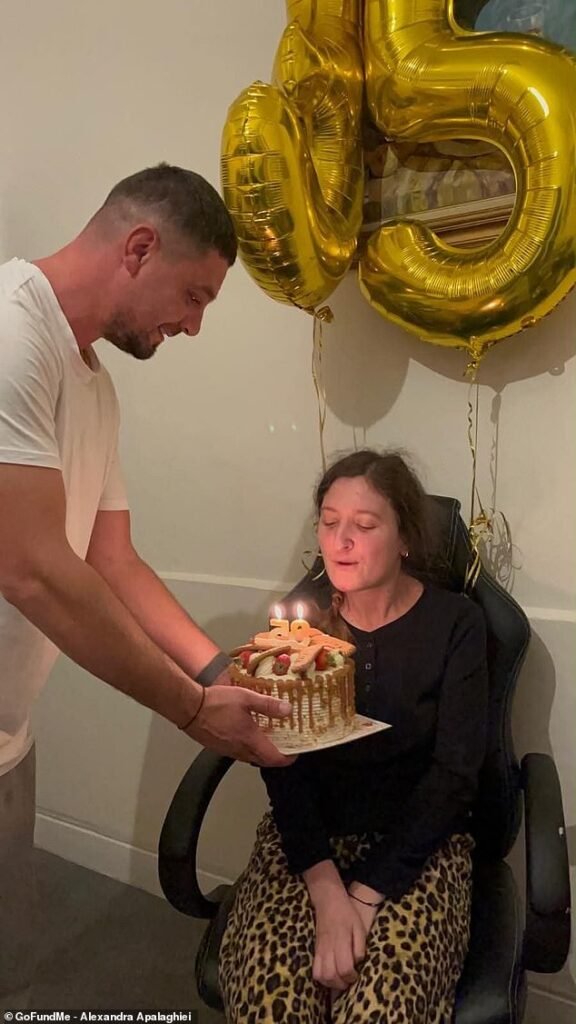
At 31 years old, Alexandra Apalaghiei was entering the prime of her life. Mother to a young son, living in London after moving from Romania in 2015, and working in the events team at a swanky five-star hotel – things were going to plan.
How cruel, then, that just four years later, she is on the brink of losing her ability to walk and talk after a devastating motor neurone disease (MND) diagnosis.
There are approximately 5,000 adults in the UK with MND, a progressive neurological condition which currently has no cure and is terminal.
MND can affect people at any age, but is particularly common among over 50s and is split into different disorders. The most common type, which Ms Apalaghiei was diagnosed with, is amyotrophic lateral sclerosis (ALS).
ALS causes the nerve cells that control movement to deteriorate, leading to muscle weakness, loss of mobility, speech difficulties, muscle twitching, as well as changes in thinking and emotional responses.
The disease rapidly robs patients of these functions, leaving them increasingly dependent on others for everyday tasks.
Ms Apalaghiei – who has now launched a GoFundMe to raise money for her family and her care – believes she first had symptoms of the disease in November 2021.
She began waking with ‘extreme stiffness’ in the morning, which was exacerbated when she suffered a fall in January 2022.

Alexandra Apalaghiei has been diagnosed with amyotrophic lateral sclerosis (ALS) – a type of motor neurone disease (MND)
‘My left shoulder started hurting, but the pain was different. It felt like it was deep in the bones,’ the now-35-year-old tells the Daily Mail.
The symptoms persisted, and by February her arm had begun to feel ‘strange’ and unusually heavy.
As the problems persisted – and new ones developed – Ms Apalaghiei contacted her GP, who she claims told her that the symptoms were most likely as a result of her fall.
In August 2022 she was then referred for an ultrasound scan, which came back clear.
But still struggling with pain, Ms Apalaghiei insisted that this was checked, and says she was only sent for an Electromyography (EMG) test and Nerve Conduction Study (NCS) in December 2022, once she mentioned that she had begun twitching frequently.
EMGs assess the health of muscles and the nerves that control them, while NCS tests measure how the nerves transmit signals. Together, the tests are used to help diagnose MND.
After months of investigations and analysis of the results, a neurologist confirmed Ms Apalaghiei’s ALS diagnosis in April 2023.
‘I had a breakdown when I got home,’ she says. ‘I was finally told by the neurologist what it is, how it progresses and the life expectancy.’
Sadly, just 20 per cent of ALS patients live for longer than five years. In many cases, the prognosis is as little as two years.
Since receiving the diagnosis, Ms Apalaghiei says her life has changed dramatically.

Ms Apalaghiei is on the brink of losing her ability to walk and talk

The mother-of-one is no longer able to carry out routine household tasks and relies heavily on her partner, who takes their son to school, helps her wash, cooks and assists with homework
She is no longer able to carry out routine household tasks and relies heavily on her partner, who takes their son to school, helps her wash, cooks, cleans and assists with homework.
Ms Apalaghiei also now needs a walking frame to get around the house – and even that is difficult.
Despite her declining mobility, she is determined to keep using her legs for as long as possible, with research suggesting exercise can increase quality of life.
‘I can stand although it’s extremely difficult, she says. ‘But my main issue is the lack of balance.
‘I have to be extremely careful with every step I take, even if I use the walking aid. One wrong step and I fall. Most of the day I sit down, and when I have to leave the house, I use a wheelchair as it’s too dangerous with the walker.’
Ms Apalaghiei says she is constantly adapting to a ‘new normal’ – relying on handrails, shower grips and specialised cutlery.
But as the illness has taken her out of work, it has placed a significant financial strain on the family.
To help ease the burden, relatives have launched a GoFundMe to raise money for medical expenses, treatments, mobility equipment and additional home care support.
The family hope the fundraiser will provide some financial security while allowing Ms Apalaghiei to focus on spending precious time with her loved ones.
The fundraiser reads: ‘Together, we can help Alexandra focus on what matters most – spending time with loved ones and fighting this battle with dignity and hope.’
