


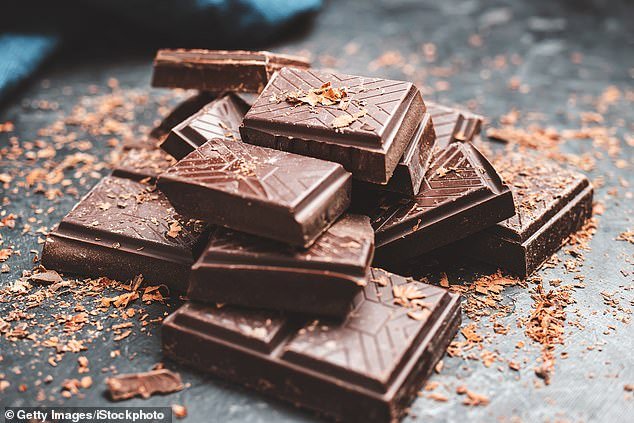
Whether snapped into squares after dinner, stirred into desserts or eaten straight from the bar, chocolate is one of the most popular treats in the world.
And it has never quite shaken its reputation as an indulgence.
But in recent years, dark chocolate has carved out a different image – marketed as the more sophisticated, less sugary option, and often associated with a range of potential health benefits.
Unlike milk or white varieties, it contains a higher percentage of cocoa solids – the part of the cacao bean responsible for its flavour, as well as many of its nutrients. It is typically richer, more bitter and lower in sugar, particularly at higher cocoa percentages.
‘A lot of people think, “Oh, it’s dark chocolate, I can eat as much as I want”, but it doesn’t work that way,’ says nutritional therapist Hanieh Vidmar. ‘It’s best to be mindful and maintain your self-control.’
That has led to a growing perception that dark chocolate is not just a treat, but something closer to a functional food – one that might even be good for you.
Yet it remains calorie-dense, high in fat and easy to overeat.
So is dark chocolate actually healthy – what does it really deliver nutritionally, and how should it be eaten?

Whether snapped into squares after dinner, stirred into desserts or eaten straight from the bar, chocolate is one of the most popular treats in the world
What’s the difference between dark, milk and white chocolate?
The key difference between the three main types is the amount of cocoa they contain.
White chocolate contains cocoa butter but no cocoa solids, while milk chocolate has a lower cocoa content and more sugar. Dark chocolate contains far more cocoa solids, giving it a more intense flavour and a stronger nutritional profile.
‘Dark chocolate is obviously the healthier option. It has more of the minerals in it, while milk chocolate is more processed and it has more sugar in it,’ Hanieh says.
‘If somebody’s following a more of a healthy lifestyle and they want to have an intake of additional minerals, additional antioxidants and additional goodness, stick to dark chocolate.
‘If you’re less worried about health, then you go for the milk chocolate and the white chocolate.
‘It just depends on what your goal is. But, ultimately, it all comes down to how processed the chocolate is. You’re more likely to get some health benefits from an organic dark chocolate rather than a Snickers bar.’
What nutrients does dark chocolate contain?
Dark chocolate has built its reputation as the ‘healthier’ chocolate largely because of its nutrient content. With a higher cocoa percentage and less sugar, it delivers more of the beneficial compounds found in cacao.
‘It’s got cacao in it, so it has high antioxidants and flavonoids,’ says Hanieh.
Flavonoids are plant compounds that act as antioxidants, helping to neutralise free radicals. They have been studied for their potential role in supporting heart health, blood vessel function and cognitive performance.
Is dark chocolate high in fat?
Yes – dark chocolate is relatively high in fat because cocoa butter makes up a large proportion of it.
Much of this is saturated fat, although one of the main types found in cocoa – stearic acid – appears to have a more neutral effect on cholesterol than other saturated fats.
‘Dark chocolate is relatively high in fat because cocoa butter makes up a large proportion of it,’ says Hanieh.
‘That’s why it’s so energy-dense, so portion size really matters.’

Dark chocolate is seen as a more sophisticated, less sugary chocolate option, often associated with health benefits, as advocated by health gurus including Gwyneth Paltrow, pictured
Is dark chocolate high in carbs and sugar?
Dark chocolate does contain carbohydrates, but generally less than milk chocolate because it has a lower sugar content.
The higher the cocoa percentage, the lower the sugar – and therefore the lower the overall carbohydrate content tends to be.
‘It does contain carbohydrates, but far less than milk chocolate,’ she explains.
‘The higher the cocoa content, the lower the sugar content tends to be, which is why I usually recommend starting at around 70%.’
How much fibre is in dark chocolate?
Dark chocolate does contain fibre, but not in large amounts unless eaten in significant quantities.
A typical portion will only provide a small fraction of the recommended 30g daily intake.
‘A 100g bar can have about 10–11 grams of fibre but I wouldn’t rely on it as the main fibre source,’ Hanieh says. ‘A small piece will give you a small amount of fibre.’
Does dark chocolate have any health benefits?
Dark chocolate is perhaps best known for its magnesium content – a mineral involved in hundreds of processes in the body, including muscle function and nervous system regulation.
‘It’s high in magnesium, plus it contains iron, copper, a little bit of zinc and a little bit of fibre. So it’s great for an intake of those main minerals,’ Hanieh explains.
‘At the end of a long, stressful day, you can have a little bit to chill when you’re watching TV. I always have a couple of squares.
‘It gives you that nice feeling and melts away in your mouth. It relaxes the nervous system because of the high magnesium content.’
Is dark chocolate addictive?
Dark chocolate itself isn’t inherently addictive, particularly compared with milk chocolate, which contains more sugar.
As Hanieh points out, overconsumption is often more about individual behaviour than the food itself.
‘It depends on the person. My husband can finish a whole bar. Is it addictive?’ Hanieh asks.
‘My mum, for example, is addicted to watermelon. She could eat three or four watermelons in one sitting, she has an addictive personality.
‘But dark chocolate has a crunch, less sugar and a bitter taste than milk chocolate, so there’s less chance of it being addictive.’
Is dark chocolate high in calories?
Dark chocolate is relatively high in calories because cocoa butter is rich in fat.
Small portions can quickly add up, so it’s worth being mindful if you are tracking intake.
‘People should be careful with eating too much if they are on a calorie deficit diet, or they’re watching their calories, because it can obviously be high in calories,’ says Hanieh.

Dark chocolate contains more cocoa solids to white or milk chocolate, giving it a more intense flavour and a stronger nutritional profile. Pictured, a vintage Black Magic dark chocolate advert
‘But I think a small portion, like one or two squares, can easily fit into a balanced diet if it’s done mindfully.’
Can you eat dark chocolate and still lose weight?
If you are strictly counting calories, dark chocolate needs to be factored in carefully.
However, it can still be included as part of a balanced approach to weight loss.
‘If somebody is on a calorie deficit diet, they can have a small amount, one or two squares – but weigh it,’ says Hanieh.
‘You can use apps to track it and see how many calories it contains, then fit it into your diet.
‘I don’t think people want to restrict themselves, but if they do it mindfully and control what they’re eating, absolutely, you can include it.
‘I wouldn’t use it as a weight loss mechanism just because it’s healthy or has certain nutrients in it. Everything in proportion and done mindfully – yes, you can always have it in your diet, but I wouldn’t use it as the only tool.’
Who should avoid dark chocolate?
Dark chocolate is generally safe in moderation, but some people may need to be cautious.
Those prone to migraines may find chocolate triggers symptoms, while its oxalate content can be an issue for people at risk of kidney stones.
People with acid reflux may also find cacao worsens symptoms, and those sensitive to caffeine may experience jitters or feel overstimulated.
‘If people have migraines, chocolate can sometimes trigger them,’ says Hanieh. ‘The oxalate content can also affect people who are prone to kidney stones.
‘If someone has GERD or reflux, cacao may aggravate their symptoms.
‘And because it contains small amounts of caffeine, people who are sensitive may experience jitters or feel hyper-alert.’
Can dark chocolate interfere with medications?
Dark chocolate can amplify the effects of stimulant medications due to its caffeine and theobromine content.
In rare cases, it may also interact with certain antidepressants. Anyone on prescription medication should check with a GP or pharmacist if unsure.
What is a healthy portion size of dark chocolate?
A standard portion is around one to two squares from a typical bar – roughly 20g.
‘It depends how big the chocolate is, but a typical bar is about iPhone size,’ Hanieh says.
‘One or two squares, maybe three, is really enough. A small portion, like 20 grams, could satisfy someone.
‘I think anything more than that, they probably won’t enjoy it – it might make you feel a bit sick.

Chefs smell chocolates during a tasting course at a chocolate convention in Lima. The three-day exhibition drew distributors from Latin America and chocolate sommeliers from Europe

Chef Maricel Presilla of the U.S. holds up a cocoa fruit during a chocolate convention in Lima
‘The darker the chocolate, the more bitter it is. You can’t really enjoy more than a few bites, so about 20 grams should give or take.’
What percentage cocoa is best?
The best option is generally 70 per cent cocoa or higher, as this provides more cocoa solids – and therefore more flavonoids and minerals – with less added sugar.
Higher percentages (85 per cent and above) contain even more cocoa compounds, although taste becomes significantly more bitter.
What should you eat dark chocolate with for maximum health benefits?
Pairing dark chocolate with nutrient-rich foods can enhance both taste and nutritional value.
Nuts add healthy fats and additional minerals, while fruit provides fibre and vitamins.
‘Lots of dark chocolates have nuts in them – hazelnuts, walnuts, macadamia nuts, for example – and fruit as well,’ says Hanieh.
‘You can add dried cranberries for extra fibre, or blueberries and strawberries. I always make strawberries dipped in dark chocolate and put them in the fridge, it’s the most amazing dessert.
‘It’s much better than milk chocolate. It obviously has more minerals and vitamins and, when you pair it with berries, you’re adding even more nutrients.’
