


Daily Mail journalists select and curate the products that feature on our site. If you make a purchase via links on this page we will earn commission – learn more
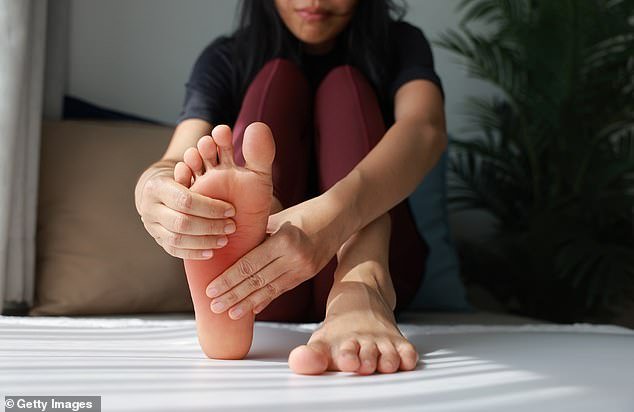
If you haven’t yet experienced the agony of plantar fasciitis, count yourself lucky, as cases of this already common foot condition are rising – driven partly by obesity and, at the other extreme, by over-enthusiastic exercising, as well as by walking barefoot on hard floors and even wearing fashionable ballet pumps.
The hallmark stabbing or burning pain that plantar fasciitis causes across the bottom of the foot – often described as feeling like walking on a stone – is often particularly bad when you take your first steps in the morning. But it can also be excruciating later in the day after standing or walking for extended periods.
And while it’s most common among those aged 40 to 60, anyone can be affected, says Robbie Ray, a consultant orthopaedic surgeon at King’s College Hospital Foundation Trust.
‘Plantar fasciitis is essentially an overloading of the thick band of tissue under the foot that connects the heel to the toes,’ he told the Daily Mail.
As a result, this band, called the plantar fascia, ‘develops tiny areas of damage where it attaches on to the heel bone,’ Mr Ray explains.
‘Think of it as a bit like repeatedly pulling on a stiff rope attached to a cleat on a boat – eventually the point where the rope attaches to the cleat will start to fray and become painful.’
And the reason the foot (only in a third of cases are both feet affected at once) hurts more in the morning is because overnight, the foot settles with the toes pointed down: the plantar fascia then contracts and tightens and stiffens in that position. Then when you first stand up, the fascia suddenly stretches and pulls on the irritated heel attachment, causing sharp pain.
After a few minutes of walking the tissue warms up and becomes more flexible, so symptoms often ease adds Mr Ray.

If you haven’t yet experienced the agony of plantar fasciitis, count yourself lucky, as cases of this already common foot condition are rising
Later in the day, especially after prolonged standing or walking, the tissue becomes overloaded again and the pain returns.
Without intervention, the condition can take months to settle.
‘The problem is that the plantar fascia has very little blood supply coming to it – and therefore if it gets traumatised or injured its healing potential is poor,’ explains Sam Singh, a consultant foot and ankle surgeon at London Bridge Hospital.
Around one in ten – or 6million people – in the UK has the condition but it is on the rise, largely due to lifestyle factors – but anyone who has gained weight to fanatic runners can develop it.
Obesity is a common cause as this puts extra pressure on the foot – but plantar fasciitis is also the most common injury to affect runners, adds Mr Ray, because running on hard surfaces or suddenly increasing the intensity of your runs can increase the strain on the plantar fascia.
Other triggers include standing for long periods. ‘In fact, the condition used to be known as “policeman’s heel” because of the amount of time bobbies used to spend on the beat on their feet,’ explains Tim Allardyce, a physiotherapist in Surrey.
Certain activities can also trigger it, such as walking barefoot on hard floors and wearing shoes with very little arch support, such as ballet pumps, he adds.
‘If you do a lot of road running or fast walking on thin-soled day-wear shoes – typical of commuters – it can also cause problems, so a slower walking pace [to shorten your stride and reduce the pulling force on the tissue], wearing shoes with soft cushioning but firm structure and reducing running distance can help with prevention.’
Plantar fasciitis can also be the result of tight calf muscles. That’s because these limit the range of movement of the ankle, forcing extra strain on to the plantar fascia, potentially stretching it, causing small tears. That’s why doing stretching exercises – such as calf stretches where you lean against a wall keeping your front leg bent and your back leg extended out straight can help avoid the problem he adds.
However, for some people, such as those with flat feet or high arches which can place continuous, abnormal stress on the plantar fascia, the condition can be hard to dodge.
If you do suffer from plantar fasciitis, here leading experts reveal the treatments really work – from simple socks to high tech options.
KITCHEN UTENSIL
‘Roll a rolling pin or a golf ball along the soft, fleshy part of the sole of the foot – between the heel and ball,’ suggests Tim Allardyce.
‘Do this, sitting down, for one to two minutes a couple of times a day, as it can help stretch the plantar fascia if it is too tight. It can really help some people.’
The same approach can be used with a frozen bottle as the cooling effect has the added benefit of reducing any inflammation present, adds Mr Singh.
SOOTHING CREAMS AND BALMS
Herbal creams designed for plantar fasciitis contain arnica, capsaicin, menthol or other herbs associated with reducing inflammation or that have a cooling effect.
‘I can’t imagine they would help long term as the plantar fascia is very deep in the foot – so it’s unlikely that any product would penetrate – probably the massaging action used when rubbing these in is what helps,’ says Mr Singh.
NIGHT SPLINTS
A form of brace worn at night, these hold the foot in a gently lifted position while sleeping to stop the plantar fascia tightening overnight.
‘What this means is that the first steps of the morning don’t involve a sudden, violent stretch of cold, contracted tissue – dramatically reducing that acute morning pain spike,’ says Ernest Barlow-Kearsley, a podiatrist at Nuffield Health Woking Hospital.
Mr Ray adds: ‘They are particularly helpful in people with severe morning pain or obvious calf tightness. Unfortunately, they can be uncomfortable to wear overnight, but it’s definitely worth a try.’
SOCKS
These are said to target the plantar fascia by applying pressure across the foot – the idea is that they provide support, promote blood flow and speed up healing.
Such socks, however, have limited benefits, says Barry Radivan, a podiatrist based in Manchester – ie, they might feel like they are doing something because of the compression effect, rather than any material change.
‘Because the tendon and ligaments that are under strain are between the heel and the arch you need something more specific for plantar fasciitis such as orthotic insoles.’
SPIKY BALLS
These are firm but slightly pliable plastic balls with protruding spikes which, when rolled under the foot, can temporarily help reduce tension in the tissues.
The balls also stimulate the small muscles within the foot itself and so may help with improving pain or mobility, adds Mr Ray.
‘They are not curing the condition directly, but many patients find they help symptoms, particularly before getting out of bed or after long periods on their feet,’ he says.
INSOLES
Insoles are said to reduce strain on the plantar fascia by improving how weight is distributed through the foot.
‘Off-the-shelf insoles suit mild-to-moderate cases,’ says Ernest Barlow-Kearsley.
‘Look for a deep heel cup of at least an inch, genuine arch support [ i.e. proper structured support not just a small foam bump in the sole], and a semi-rigid construction that controls pronation [inward rolling of the foot] without causing discomfort.’
However, for persistent plantar fasciitis it’s better to speak to a podiatrist or foot specialist about custom-made orthotics as these will work more precisely with the individual needs of your foot.
SHOES
To help manage plantar fasciitis you need shoes with a firm heel counter – the bit that cups the heel, a stable non-twisting midsole, good heel cushioning, and a roomy toe box, says Ernest Barlow-Kearsley.
‘Canvas trainers, ballet flats, and flip-flops are among the worst possible choices because they offer virtually no support to the heel arch area’
Shoes such as the Toffeln SmartSole Breeze Trainer – part of their plantar fasciitis range – offer shock absorbency, a raised heel and the ability to redistribute the weight away from the damaged tissue.
Shock absorbing trainers won’t help unless they enough arch support, and a raised heel.
SHOCKWAVE THERAPY
This non-invasive procedure involves using a device known as an ‘air hammer’ or probe on the surface of the skin through which high intensity sound waves are applied to the foot. This is to intentionally irritate the plantar fascia explains Mr Singh.
‘By hammering the deep tissue we trigger the body to react with acute inflammation, which can be painful but also brings good healing factors to the area which may help the plantar fasciitis damage to heal.’
There’s limited availability in NHS clinics but is available privately at £60–£120 per session. Most people need three to six sessions.
Mr Ray adds that there is good clinical evidence that this can benefit those who have symptoms lasting more than six months that have not improved with stretching and footwear changes.
It is not an instant fix, he says, but there will be a gradual improvement over six to 12 weeks.
A 2023 study published in Frontiers in Immunology showed the benefits persisted longer term (up to a year) following treatment.
SURGERY
In cases where all treatments fail, a procedure known as topaz ablation, carried out by an orthopaedic surgeon, may help.
‘A small wand uses radiofrequency energy i.e. heat energy to create multiple tiny perforations within the diseased portion of the plantar fascia,’ says Mr Ray.
‘The goal is to stimulate a healing response.’
Unlike shockwave which is non-invasive and working from outside the body using sound waves, this is minimally invasive since it physically, though minimally penetrates the tissue
It isn’t always available on the NHS.
The cost is £1,500 to £3,500 privately. A pooling of studies published last year in the Journal of Clinical Medicine found over 85 per cent of patients reported a good outcome. All the studies included were however small.
