


On Wednesday, the White House confirmed that Americans potentially exposed to Ebola would be quarantined at a specialist facility in Kenya.
But plans for the field hospital now already appear to be in jeopardy – after a court in Kenya stepped in to block them.
The High Court in Nairobi, Kenya’s capital, said Friday that the plans could not continue until petitions against them were heard, with hearings scheduled for Tuesday.
Several organizations in Kenya have campaigned against establishing any Ebola-related facilities, citing concerns over public health and a lack of public participation.
The Kenyan government has only confirmed that it is in discussions with the US on preparedness for Ebola, but has not addressed the facility.
Senior US officials have said the 50-bed facility would be set up at an air force base in central Kenya, would serve Americans potentially exposed to Ebola who did not have symptoms, and would be operational Friday.
Meanwhile, health officials are continuing to struggle to contain the outbreak of the rare strain of Ebola, which kills up to 50 percent of everyone it infects.
The World Health Organization said Friday that there were 906 suspected cases of Ebola in the Democratic Republic of Congo alone, including 223 suspected deaths that were being investigated. The country’s government has reported more than 1,000 suspected cases.

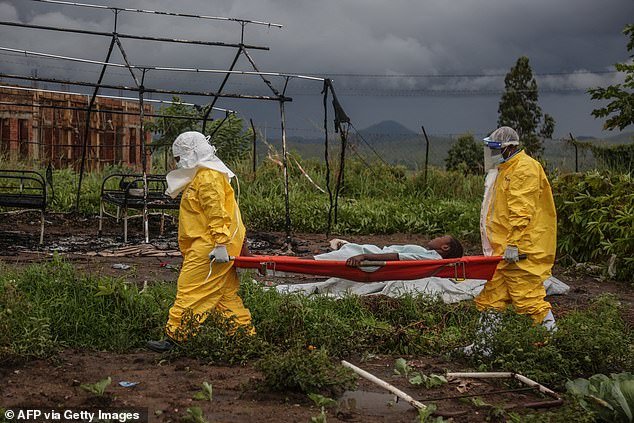
Kenya’s high court has blocked plans for a US Ebola facility in the country. The above photo shows medical staff carrying a patient at a medical facility in the Democratic Republic of Congo

Workers are shown above in Bunia, the DRC, burying a doctor who died from the virus
There have also been seven confirmed cases of the virus in Uganda, three of which were imported from the DRC, and one confirmed death.
Experts anticipate that this number will continue to rise.
‘The outbreak is completely out of control,’ Dr Richard Kojan told ABC.
Kojan is a physician working in the Ituri province, which is the hardest hit by the virus, and president of the Alliance for International Medical Action who has been involved in multiple previous Ebola outbreaks.
Another clinician, Dr Richard Lokudi, director of a hospital in Mongbwalu, told ABC that the disease was spreading ‘at an exponential speed’ and that seven symptomatic patients suspected of having Ebola had recently ‘escaped’ from the hospital.
This, Lokudi told the outlet, was creating ‘chains and chains of contamination’ and making the outbreak ‘difficult to fight.’
At this time, it is unclear whether the new facility will be built or whether the Kenyan government has signed off on the plan. The Daily Mail has contacted the White House for comment.
The plans were blocked by the Kenyan High Court after an organization formed to defend Kenya’s Constitution, Katiba Institute, and the Kenya Law Society separately challenged any presence of Ebola-related facilities.
The Kenya Law Society asked the court to nullify any agreements signed between the US and Kenya on the project, citing public health risks and a lack of public participation.
It also said that Kenya lacks ‘the high-containment infrastructure required to safely manage such a facility, exposing the public to serious health risks’.
A Kenyan doctors’ union on Thursday issued a 48-hour strike notice should the country proceed with the deal.
It said the US was clear that they would not allow Ebola on their soil and therefore Kenya should not become another ‘dumping ground’.

Shown above are workers spraying disinfectant in Kampala, the capital of Uganda, after Ebola was reported in the country

Workers pictured spraying disinfectant in Kampala, Uganda
The union’s chairman, Davji Atellah, said in a statement: ‘As the vanguard of Kenya’s healthcare system, we are utterly disgusted by the government’s apparent willingness to trade national biosecurity and the lives of its citizens for foreign aid.’
Secretary of State Marco Rubio has said the US plans to commit $13.5 million to Kenya’s Ebola preparedness efforts.
He has vowed not to allow Ebola to reach American soil, saying at a cabinet meeting Wednesday: ‘The number one priority of our foreign policy is to protect the American people. We cannot and will not allow any cases of Ebola into the US.’
He added that the US government was ‘working very, very hard to contain this crisis to the countries where it is currently located’.
Estimates suggest up to 5,000 Americans are in the DRC, although it is not clear how many are in Uganda.
The Ebola outbreak started in the eastern DRC around two months ago, the WHO said in early May.
There were delays in detecting the infections, however, owing to difficulties transporting samples for testing, which allowed time for the disease to spread.
The outbreak is being caused by the rare Bundibugyo strain of the virus, for which there is no vaccine.

The above shows medical supplies from Europe arriving in Bunia, the DRC, which is at the center of the outbreak
Health officials have been alarmed by how long the strain went undetected while spreading across a densely populated area, making it difficult to trace and isolate infected individuals.
Early warning signs are often similar to the flu, and include a fever, severe headache, fatigue or weakness, but can quickly progress to vomiting, diarrhea and unexplained bleeding or bruising.
Without treatment, the disease can also cause internal bleeding, which leads to death.
Ebola, however, does not spread as easily as Covid or the flu. To pass it on, someone has to come into contact with infected fluids from another patient.
Officials introduced travel restrictions for people coming to the US from the Democratic Republic of Congo, Uganda and South Sudan last week, requiring any passenger who has visited these countries within the last 21 days to arrive via George Bush Intercontinental Airport in Houston, Washington Dulles International Airport and Hartsfield-Jackson Atlanta International Airport for screening.
Last week, a flight from Paris to Detroit was forced to divert to Canada after it emerged that a passenger from the Ebola-hit Democratic Republic of Congo was on board.
The CDC and other health officials say the risk posed by the virus to people in the US and Europe is currently low.
