


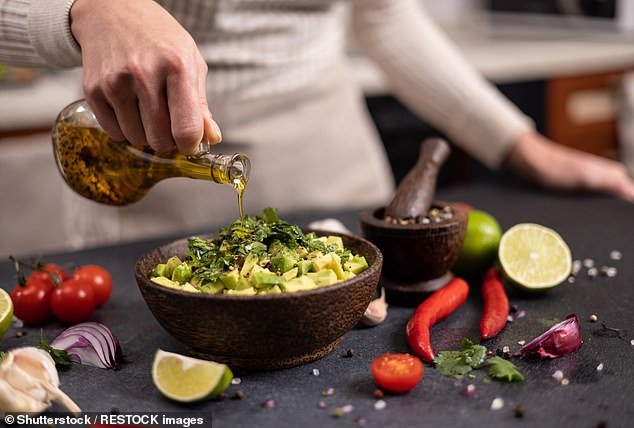
It is a staple found in kitchen cupboards across the world – drizzled over salads, stirred into pasta and used to roast everything from vegetables to fish.
Celebrities including Jennifer Lopez, Kourtney Kardashian and Gwyneth Paltrow have all praised olive oil for its health benefits.
Now scientists say even a small daily drizzle could potentially slow ageing.
Researchers believe olive oil’s healthy fats and antioxidant plant compounds may help protect blood vessels, reduce inflammation and support heart health – helping explain why Mediterranean-style diets have long been linked to longer life expectancy and lower rates of cardiovascular disease.
The recent study, presented at the European Congress on Obesity in Istanbul, found people who consumed the highest amounts of polyphenol-rich foods – including olive oil, fruit and coffee – had a significantly lower risk of accelerated biological ageing.
‘These plant compounds may help protect cells from oxidative stress and low-grade inflammation, both of which are linked with ageing and long-term disease risk,’ says registered nutritionist Rob Hobson.
The study found that people who ate the highest amounts of polyphenols had a 52 per cent lower risk of a faster telomere shortening rate compared with the group who ate the least. The effect was most pronounced in adults under the age of 64.
In order to understand why olive oil can be beneficial to ‘healthy ageing’, it’s helpful to understand what polyphenols are.

Olive oil is very versatile and can be used for cooking, pouring over salads and dipping bread
Polyphenols are the plant pigments responsible for the vivid colours in fruits and vegetables, such as the deep blue of blueberries or the red of onions.
The highest polyphenol olive oils are typically early-harvest and cold-pressed – where the oil is extracted using a manual press rather than heat, which can remove healthy nutrients.
‘Extra virgin olive oil contains a range of polyphenols, including oleocanthal, which is thought to contribute to some of its antioxidant and anti-inflammatory effects,’ says Hobson.
High-polyphenol olive oil often has a vibrant, dark green colour. Its presence is often detected by a bitter, grassy taste and a peppery, ‘throat-burning’ sensation.
This pungency – or ‘cough-factor’ – is caused by specific phenolic compounds, notably oleocanthal, found in extra-virgin olive oil.
The team at the University of Navarra looked at 1,709 adults in Spain, who had their diet monitored for nearly a decade.
Their DNA was analysed over an eight-year period to measure a key biological marker of ageing called telomeres.
Telomeres are a ‘cap’ of DNA sequences found on the end of chromosomes, which naturally shorten as people age, acting as a biological clock.
A faster telomere shortening rate is linked to visible signs of ageing such as wrinkles, as well as chronic diseases including cancer and Alzheimer’s.
How olive oil may protect the heart
Previous studies have also suggested olive oil may help protect the heart from environmental stress.
Research presented at the 2014 American Thoracic Society International Conference found that small daily amounts of olive oil appeared to reduce some of the harmful cardiovascular effects linked to air pollution.
In the study, led by scientists from the United States Environmental Protection Agency, healthy volunteers were exposed to controlled levels of polluted air after several weeks of either olive oil supplements, fish oil supplements or no supplements at all.
The research found exposure to pollution caused narrowing of blood vessels – a response linked to increased blood pressure and cardiovascular strain – but the effect was reduced in the group taking olive oil.
They also found signs olive oil may help the body break down dangerous blood clots more effectively.
Put simply, high-polyphenol extra virgin olive oil helps keep blood vessels flexible and reduces inflammation.
Is there a difference between extra virgin olive oil and regular olive oil?
Extra-virgin olive oil is the highest-quality olive oil – and, while more expensive, experts say it is also has the greatest health benefits.
Since it is cold-pressed, extra-virgin olive oil contains higher levels of polyphenols, meaning, according to research, it is more likely to slow ageing than regular olive oil.
Regular olive oil is typically a blend of refined oil – where it is heated and chemicals are sometimes added – as well as smaller amounts of virgin olive oil.
Since regular olive oil doesn’t require strict manufacturing or taste standards, it is much more affordable than extra-virgin olive oil.
But this also means that it contains fewer polyphenols, which, according to experts, makes it less healthy.
Regular olive oil has a more neutral flavour profile than extra-virgin olive oil. It is also usually lighter in colour and aroma.
In the UK, you can expect to pay around £7-£8 for one litre of supermarket own-brand extra virgin olive oil, with premium brands fetching up to £16. One litre of regular olive oil typically costs around £5-£6.
What foods should I combine with olive oil?
Experts say that olive oil is best eaten with a Mediterranean diet – one that is rich in fresh fruit, vegetables, pulses, and fish.
A Mediterranean diet is also light in red meat and processed foods – like sugary snacks and pastries.
‘This research presented at the European Congress on Obesity is interesting because it adds to the idea that polyphenol-rich foods may support healthier biological ageing, but this is not about one magic food,’ says Hobson.
‘Extra virgin olive oil is best seen as part of a wider Mediterranean-style diet rich in vegetables, fruit, beans, lentils, nuts, seeds and wholegrains.’
Prior research led by scientists at King’s College London has suggested compounds in olive oil may also interact with nitrate-rich vegetables found in the Mediterranean diet such as spinach, lettuce and celery to help regulate blood pressure.
The findings, published in the journal Proceedings of the National Academy of Sciences, found that when compounds from olive oil combine with dietary nitrates they can form molecules known as nitro fatty acids.
Experiments in mice suggested these compounds may help lower blood pressure.
Professor Philip Eaton, Professor of Cardiovascular Biochemistry at King’s College London, said the findings may help explain why Mediterranean diets supplemented with olive oil have long been associated with lower rates of stroke, heart failure and heart attacks.
Experts stressed, however, that much of the evidence remains observational or experimental, with some studies conducted in animals or involving relatively small numbers of participants.
Researchers also cautioned that olive oil is not a ‘miracle food’, and can be harmful if consumed in large amounts.
Olive oil is rich in monounsaturated fats, which are considered heart-friendly when they replace saturated fats in the diet.
Despite its potential health benefits, experts warn olive oil is still calorie-dense, containing around 120 calories per tablespoon.
Researchers said the benefits are most likely seen when olive oil replaces less healthy fats rather than simply being added to an already energy-rich diet.
While olive oil alone is unlikely to be a magic bullet for longevity, scientists say simple dietary habits followed consistently over time may play an important role in healthier ageing.
What is the Mediterranean diet?

The Mediterranean diet has received significant attention in recent years
The traditional Mediterranean diet is based on foods available in countries that border the Mediterranean Sea.
The foundation for this diet includes:
- Eating lots of plant foods, including fruits, vegetables, whole grains, nuts, and legumes, which are minimally processed, seasonally fresh, and grown locally
- Olive oil as the principal source of fat
- Cheese and yogurt, consumed daily in low to moderate amounts
- Fish and poultry, consumed in low to moderate amounts a few times a week
- Red meat, consumed infrequently and in small amounts
- Fresh fruit for dessert, with sweets containing added sugars or honey eaten only a few times each week
- Wine consumed in low to moderate amounts, usually with meals
