


A major scientific review has delivered a stark warning about alcohol’s impact on health.
World Health Organization researchers found that drinking alcohol is linked to more than 60 disease, and listed multiple types of injuries that are entirely attributable to its consumption.
However, the review also suggests that some alcohol-related harms may improve if consumption is reduced or stopped.
The study, published in the journal Addiction, brings together current evidence on alcohol-related disease burden and confirms that alcohol is directly responsible for a range of serious conditions, including alcoholic liver disease such as cirrhosis and foetal alcohol syndrome.
These are among the conditions classified by the World Health Organization as fully attributable to alcohol consumption, most commonly associated with long-term heavy drinking.
The researchers also highlight that alcohol’s impact extends beyond conditions wholly caused by drinking, contributing to increased risk across multiple organ systems.
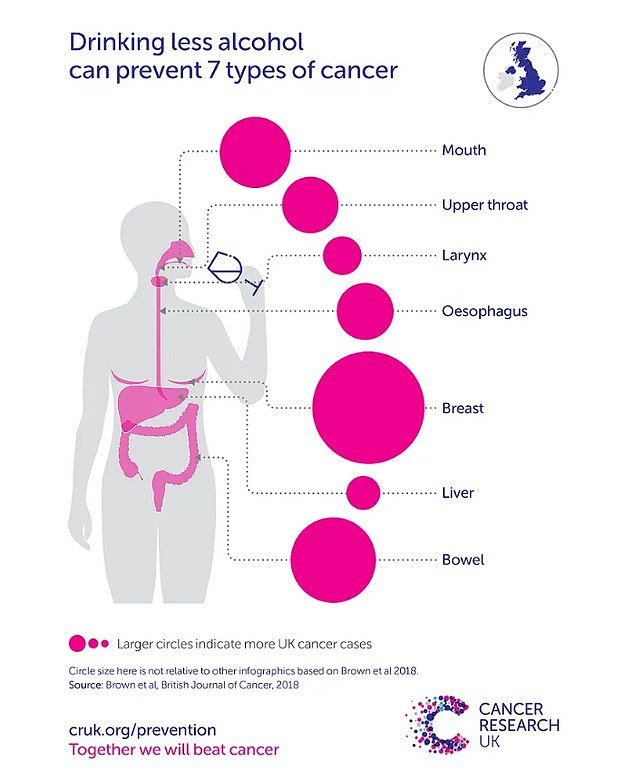
These include several cancers, such as those of the mouth, throat, oesophagus, liver, bowel, breast and cervix, as well as cardiovascular conditions including high blood pressure, stroke, atrial fibrillation, cardiomyopathy and ischaemic heart disease.
Alcohol is also associated with an increased risk of type 2 diabetes, neurological conditions including dementia and epilepsy, and gastrointestinal diseases such as pancreatitis.

Cutting down on alcohol can reduce the risk of developing breast, colorectal, stomach, head and neck, liver and mouth cancers
The review notes that alcohol consumption is associated with a higher risk of infectious diseases, including tuberculosis, pneumonia, HIV and other sexually transmitted infections.
This increased risk is largely driven by alcohol’s effects on immune function and, in some cases, by behavioural factors that increase exposure to infection risk.
In addition, alcohol significantly increases the risk of injury by impairing balance, reaction time and judgement, raising the likelihood of accidents, violence and traffic-related harm.
The review emphasises that injury risk can occur during episodes of intoxication and is influenced by both the amount consumed and the surrounding context.
One of the key findings of the review is that some alcohol-related harms may improve if drinking is reduced or stopped.
Short-term risks such as injuries or infections acquired during intoxication decline once alcohol use ceases.
Some cardiovascular effects may improve within days to weeks of abstinence, and aspects of immune function can recover over time.
However, the authors caution that long-term heavy alcohol use can result in lasting damage, and conditions such as cirrhosis and heart disease are not always fully reversible, although progression may be slowed.
Evidence also suggests that some alcohol-related brain changes may partially improve with sustained abstinence, although longer-term risks, including dementia, may persist.
The study also addresses the ongoing debate about whether low levels of alcohol consumption may offer any protective effect for cardiovascular health.
Senior author Dr Jürgen Rehm of the Canadian Centre for Addiction and Mental Health noted that while some earlier observational research suggested possible benefits for ischaemic heart disease and stroke, more recent evidence, including genetic analyses, remains inconclusive.
The authors concluded that there is insufficient evidence to rule out any protective effect, but emphasised that this does not outweigh the broader harms associated with alcohol consumption.
Lead author Sinclair Carr of Harvard T.H. Chan School of Public Health concluded that alcohol is a major cause of disease and injury, and that its overall harms outweigh any potential benefits.
Separate research consistently links alcohol consumption with an increased risk of several cancers, including breast, colorectal, liver and head and neck cancers.
Alcohol is believed to contribute to cancer development through mechanisms such as oxidative stress, inflammation and metabolic breakdown into acetaldehyde, which can damage DNA.
In women, alcohol can also increase oestrogen levels, which is associated with a higher risk of breast cancer.
Cancer Research UK estimates that around eight per cent of breast cancer cases in the UK are linked to alcohol consumption, with risk increasing with higher average daily intake.
The NHS recommends adults drink no more than 14 units a week, spread across three days or more.
