
Subscribe to Updates

    Get the latest creative news from FooBar about art, design and business.

    What's Hot

    The 30p supplement that helps you keep the weight off AND slashes your risk of diabetes. Now our experts reveal why people trying to get off Mounjaro must take it – and how it can stop this common side-effect

    Hantavirus News Roundup: From Céline Gounder of KFF Health News 

    Major scientific review confirms alcohol causes dozens of health issues – but some are reversible if you quit boozing now

    Facebook Twitter Instagram
    Facebook Twitter Instagram
    HealthOptiBodyHealthOptiBody
    Subscribe
    • Home
    • Healthy News

      Hantavirus News Roundup: From Céline Gounder of KFF Health News 

      Trump and Kennedy Seek To Relax Safeguards for AI Healthcare Tools

      RFK Jr. Swaps Vaccine Talk for Healthy Foods and Reading to Tots in Push To Woo Voters

      Low Wages, Empty Plates, Heavy Toll: Rethinking Suicide Prevention

      As Ranks of Uninsured Grow, Minnesota’s Hospitals Are Among Least Charitable in Nation

    • Healthy Food
    • Lifestyle
    • Disease
    • Nutrition
    • healthy living
    HealthOptiBodyHealthOptiBody
    Home»Hot»Simple test can predict if a person will die within 24 hours – doctors claim it is 95 per cent accurate
    Hot

    Simple test can predict if a person will die within 24 hours – doctors claim it is 95 per cent accurate

    Hill CastleBy Hill CastleNo Comments3 Mins Read
    Facebook Twitter Pinterest LinkedIn Tumblr Reddit WhatsApp Email
    Share
    Facebook Twitter LinkedIn Pinterest WhatsApp Email

    By JONATHAN NEAL, HEALTH REPORTER

    Published: 08:26 EDT, 25 April 2026 | Updated: 08:26 EDT, 25 April 2026

    A simple bedside test could help doctors predict whether a person is likely to die within 24 hours, researchers say.

    The technique involves checking the corneal reflex – the automatic blink response that happens when the surface of the eye is gently touched.

    Scientists found patients who had lost this reflex were far more likely to die within the next day, raising hopes the method could help families prepare for a loved one’s final hours.

    Experts said recognising when death is close is one of the most difficult parts of end-of-life care, yet one of the questions relatives ask most often is how much time remains.

    The study, published in BMJ Supportive and Palliative Care, was led by Dr Jung Hun Kang, director of the hospice centre at Gyeongsang National University Hospital in South Korea.

    He said: ‘Family members often place great importance on being present at the moment of death.

    ‘That often leads to difficult and urgent questions about how much time remains.’

    Doctors and nurses already look for signs that a patient may be nearing death, including changes in breathing, bluish skin caused by poor circulation and reduced consciousness.

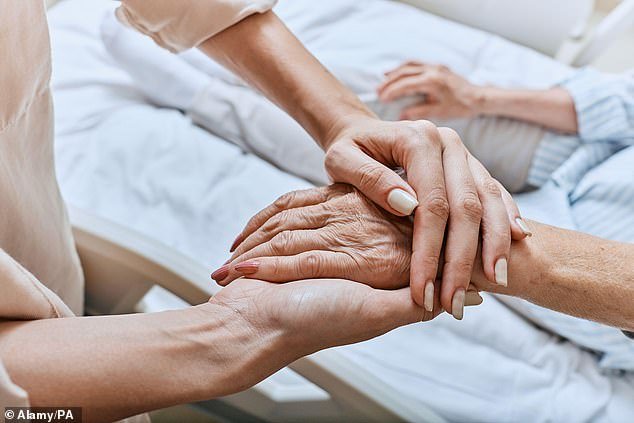
    A simple bedside test could help doctors predict whether a person is likely to die within 24 hours, researchers say

    A simple bedside test could help doctors predict whether a person is likely to die within 24 hours, researchers say

    Previous research suggests identifying these warning signs can indicate a 95 per cent probability of death within 48 hours.

    But the new study suggests the corneal reflex may narrow that window further.

    Researchers monitored 112 hospice patients with advanced cancer who had been judged to have only one to two weeks left to live.

    Nurses checked the corneal reflex three times a day by approaching from the side – in order to avoid triggering a visual response – and gently touching the cornea with a sterile cotton wisp or strand of gauze.

    Responses were recorded as intact, diminished or absent.

    Of the 112 patients, 110 died within seven days.

    Those with an absent corneal reflex were more than five times as likely to die within 24 hours than patients whose reflex was still present or only diminshed.

    The 24-hour mortality rate among patients with no reflex was 70.7 per cent.

    Dr Kang said loss of the reflex may reflect worsening failure of the brainstem – the part of the brain that controls basic life functions such as breathing and consciousness – during the natural dying process.

    He added that while the sign may strongly support a prediction of imminent death, its presence does not rule it out.

    The researchers also found the test was especially useful when combined with another measure known as the Richmond Agitation-Sedation Scale, which assesses alertness and sedation.

    Among deeply sedated patients, 71.2 per cent of those whose corneal reflex was absent died within 24 hours, compared with 37.1 per cent whose reflex remained.

    David Hui, director of research for supportive and palliative care at MD Anderson Cancer Center in Houston, who was not involved in the study, said the results were comparable to other recognised late signs of dying.

    However, he cautioned that the research was relatively small and involved only hospice patients with advanced cancer.

    The team now plans larger studies in a broader range of patients.

    Experts said if confirmed, the test could become a valuable tool to help clinicians give families clearer answers and allow patients to receive more peaceful and dignified care in their final hours.

    Share or comment on this article:
    Simple test can predict if a person will die within 24 hours – doctors claim it is 95 per cent accurate

    Previous ArticleHow deadly is YOUR favourite cuppa? Experts reveal teabags that may be releasing billions of microplastics
    Next Article The 8 cent supplement hailed as ‘budget Ozempic’: Few people have heard of this ultimate slimming hack… now experts explain exactly how it can cut cravings instantly and shift stubborn stomach fat in weeks
    Hill Castle
    • Website

    Related Posts

    The 30p supplement that helps you keep the weight off AND slashes your risk of diabetes. Now our experts reveal why people trying to get off Mounjaro must take it – and how it can stop this common side-effect

    Major scientific review confirms alcohol causes dozens of health issues – but some are reversible if you quit boozing now

    Mona Lisa was overweight and Ozempic-like drugs could ruin contemporary art, expert claims

    Leave A Reply Cancel Reply

    Stay In Touch
    • Facebook
    • Twitter
    • Pinterest
    • Instagram
    • YouTube
    • Vimeo
    Don't Miss
    Healthy News

    One Major Effect Coffee Has on Your Body, New Study Says

    By Hill Castle0 Healthy News

    To understand the new smart monitors and other pro devices of tech health, we should…

    Do Antacids Affect Kidneys, and Also Lead to Osteoporosis?

    Spine Devices Market to Surpass US$ 17 Bn as Demand Rises

    5 Best Probiotic Supplements for Gut Health in 2021

    Our Picks

    The 30p supplement that helps you keep the weight off AND slashes your risk of diabetes. Now our experts reveal why people trying to get off Mounjaro must take it – and how it can stop this common side-effect

    Hantavirus News Roundup: From Céline Gounder of KFF Health News 

    Major scientific review confirms alcohol causes dozens of health issues – but some are reversible if you quit boozing now

    Mona Lisa was overweight and Ozempic-like drugs could ruin contemporary art, expert claims

    Subscribe to Updates

    Get the latest creative news from SmartMag about art & design.

    Demo
    Facebook Twitter Instagram Pinterest YouTube
    • Home
    • Healthy News
    • Healthy lifestyle
    • Disease
    © 2026 DailyHealthybox. Designed by HealthOptiBody.

    Type above and press Enter to search. Press Esc to cancel.