

In Part One, Philip Nolan brought readers inside what it felt like to suffer a stroke. In this second part of the series, originally published just before Christmas, we see how physiotherapy and a grudging acceptance that he has to give up the vices that made him himself, mean Philip can now walk, talk, work and live independently…
THE atmosphere in Wexford General couldn’t have been more different than it had been in Rome’s Policlinico Umberto I hospital.
Perhaps it’s the fact Wexford is lot smaller and more intimate, but it probably came down to something much simpler – the language.
I’m not one of those people who thinks everyone should speak English, and I certainly don’t equate comprehension with ever-increasing volume – the old ‘what time is Mass? WHAT TIME IS MASS?’ syndrome – but it was great to finally understand and be understood.
My brother Mark had liaised with my office from Rome, and accompanied me on the Lear jet insurance flight to Dublin.
An ambulance was waiting on the apron and sped me to Wexford, my vital signs being assessed the entire time.
When we arrived, it was so typically Irish. ‘We’ve heard all about your stroke,’ the nurse said. ‘I couldn’t care more for you if you were a member of my own family.’
It was a lovely thing to hear. The medical notes from the hospital in Italy were incredibly detailed, but Wexford General, to their credit, made sure all the diagnostics were repeated.

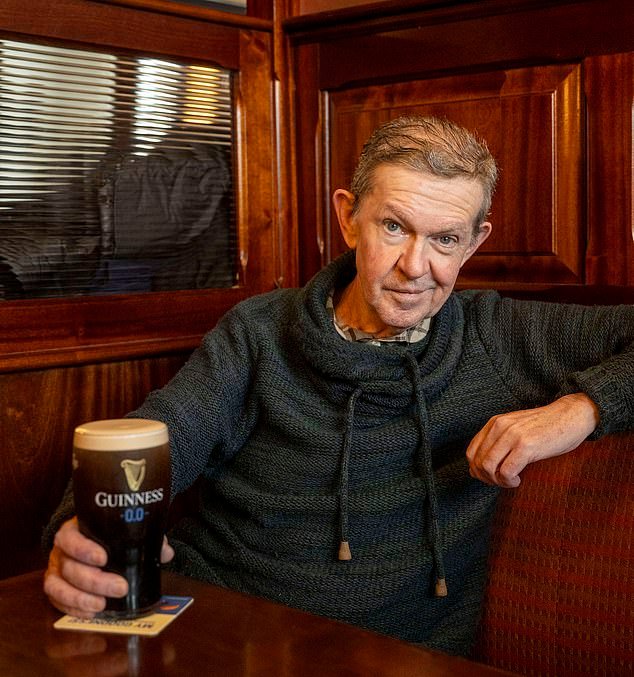
Philip with a pint of Guinness Zero Zero – since his stroke he only occasionally has had a small glass of wine or whiskey
I can’t remember how often I was sent for ultrasounds, but it was a lot, and they revealed pretty much the same things. I have atherosclerosis, but my heart itself, and my lungs, are fine.
The brain, well, that was a different story? I wasn’t in Wexford General by choice. I moved to the county years ago, but my siblings and most of my friends live in Dublin, and visits would have been a lot simpler, and more frequent, if they hadn’t required the schlep of a three-hour round trip.
The rules, though, say you must present at the nearest hospital, so while Vincent’s would have been more practical, Wexford it was.
As it happens, everyone visited anyway, and we were lucky in May with the weather. Afternoons were spent outdoors as I was taken by wheelchair to the café, by family, extended family, school friends, college pals, newspaper colleagues, even social media friends.
I couldn’t walk and, as I learned much later, the doctor who greeted me wasn’t sure I’d ever regain use of my right arm. I could have a coffee, though, and despite my diabetes may have had the occasional muffin too.
Life is a constant tightrope – what often isn’t great for physical health works wonders at sustaining your mental health. Sometimes, you have to just go for it.
Buoyed by the steady stream of visitors, cheered by what seemed to be endless sunshine, and delighted to have a room to myself, I relaxed for the first time.
The physio was going well too. An electric stimulator showed results with the fingers of my right hand, but while it was promising, I refused to get excited just yet. There was a long road ahead.
Getting into the National Rehabilitation Hospital in Dún Laoghaire is difficult – apparently it has a waiting list longer than War And Peace – but a place specialising in physio for stroke had been found for me elsewhere.
On the morning of May 21, I set out for St John’s Community Hospital in Enniscorthy. It would be my home for over three months.
I RECOGNISED the hospital straight away, because I had been to the old part before, for my Covid booster injection. I knew Enniscorthy too, since that’s home to the clinic where I have my eyes tested every year for diabetic retinopathy.
The new hospital, with three wings arranged around central courtyards, serves many functions. Part nursing home for the elderly, it also offers respite care, and it’s a step-down centre.
Grand for those who could step down, of course, but since I couldn’t walk at all, never mind tackle a step, I was there to learn how to do it again, 60 years after I walked in the first place.
On Twitter/X, I was asked where I was exactly. What started as a trickle became a deluge, of getwell cards, presents, even the book Scrublands from Bendigo in Australia. People often bitch about social media, but it has a good and warm side too.
The physios there, and the occupational therapists, would rather not be named; their admirable attitude is that they’re just doing a job and don’t need anything in the way of praise.
For the record, though, they’re angels. They also remind us of one thing – with patients from their early 40s to a great deal older, anyone can have a stroke. One of the staff there tried to highlight this with meetings of stroke survivors, but I went just the once.
No two strokes are the same – different strokes for different folks, and all that – so all we had in common, really, was negative, and my nature won’t allow me dwell on that.
What I did know, though, was that if the hand was to come back, it would be the last thing. Everything else would come before.
There were other challenges. Because my mouth drooped on one side, I had difficulty pronouncing words where the second letter was R – the likes of droop itself, which came out as ‘dwoop’, along with frog, grass, bread, and so on.

Philip had to teach himself to walk again – a gradual process which was aided by a splint on his right leg
I had sheet after sheet of such words, and phrases (‘phwases’ again) that included them. Practice did make perfect, thankfully. No pwactice anymore.
The wifi in my room (there was a second bed but, glory be, it was only occupied for a short time) was non-existent, and the televisions throughout had only the Irish stations because they operated on Saorview.
It was the source of much amusement back in the day that my late mother was a huge fan of The Chase and Tipping Point, but not quite as funny when, to my shame, I lived for both as well.
At night, thankfully, I had the BBC on SkyGo, so I was able to watch the likes of Glastonbury on my iPad with a Bose Bluetooth speaker to ensure the sound was perfect too.
The only downsides were that I still had to be taken everywhere on a Sara Stedy, a contraption on wheels; I still had to have the catheter bag emptied: and I still had to wear nappies, and have them changed. Dignity went out the window.
THE physio progressed apace. I started with simple tasks, clasping a large ball between my knees, rubbing my foot on a pad, and so on.
All exercises at the start were conducted on my back. I learned how to transfer from a wheelchair to a bed, and how to place both feet on the ground.
Other tasks involved Velcro, and tubes that were placed over each other in an arc, and games that all involved the same thing – repetition. Over and over again, it was monotonous work, but it had to be done.
There were diverting moments. We often went to the nearby 1798 interpretive centre, where the cafe does great sandwiches and good coffee. The food in the hospital didn’t really suit me;
I’d never have dinner in the middle of the day, I wouldn’t even contemplate having my tea at 5pm, and I certainly wouldn’t be a meat and two veg man, so variety outside was welcome.
As soon as I learned how to transfer to the passenger seat of a car, my younger sister, Joyce, and Mark and his wife Claire and I, and friends, struck further afield.
There was an excursion to Aldi in Wexford town, and being taken by wheelchair to Frank’s for a seafood lunch; to Cois na hAbhann garden centre near Camolin, and Jack’s Tavern in the village itself; to Sean ?g’s bar in Kilmuckridge on a perfect sunny Sunday; and to the Bailey in Enniscorthy.
I learned gradually how to walk while being held upright by others, before progressing to a splint on my right leg. I tried a stick but didn’t like it, so I concentrated on the bars.
Gradually, I started to walk again, forwards, backwards, sideways. I learned how to mount steps and negotiate stairs.
With the occupational therapist, the arm was coming back. I’m a good cook, and I made scones for the first time, then moved on to main courses.
I stacked and emptied the dishwasher, and stopped sending laundry home with Joyce just as soon as I could do my own.
The catheter had been removed, I could go to the loo at this stage, and I could shower too.
The arm, I felt, had gone as far as it could, and what it needed now was real-world use if it was to progress. In truth, I also was bored, and I made a decision.
After a trial run on August 3, and a set of photos of my house so recommendations could be made, I was going home for good on August 29.
I made one modification to my house, a grab rail in the shower. I don’t really need it, but when shampoo gets in my eyes, I’m glad of it. Otherwise, I’m perfect, as if the stroke never happened at all, right?

Philip Nolan, well on the road to recovery from a stroke, visits Hook Lighthouse in Co Wexford
Wrong. While I was in hospital in Enniscorthy, I had my 62nd birthday, and I have to remember that the life I had, the life I enjoyed, is over. Some of it for now, some of it forever.
The hand is much better than it was, but while I can type, and therefore work, I can’t write properly. I can’t sign my name.
There’s no precision there. I can’t throw, because the hand doesn’t know when to let go. I knock things over, because I’m horribly clumsy.
On the right side of my body, literally from half way down my nose, there’s a numbness. It’s much better than it was, but still there.
I can’t feel temperature on the right side. Whether it’s the shower, the hob, the oven or the fire, I have to test with the left hand first.
There are promising signs, insofar as I get a sharp feeling in my hand if it encounters something really hot. It knows it shouldn’t be there, but can’t yet feed the entire suite of information – or perhaps, my brain gets the information, but doesn’t know how to process it.
Everything physical takes longer than before, but everything mental does too. I can’t make a decision as quickly as I used to.
There are only seconds in the difference, but I need them to absorb information that used to reach my brain a lot quicker. I don’t use a rollator, or walker, anymore, but I do like to link my sisters, or keep hold of a shopping trolley, when I’m out.
I don’t wear the splint in the house, but I like the added security on hard surfaces beyond, be they paths, roads, whatever. One way or the other, I always wear high-sided runners or boots for support.
At my heaviest, I weighed 103kg. When I had the stroke, I was 87kg. Now, I’m 63.5kg. That’s 10st on the nose in old money, I’ve gone from a 38′ to 30′ waist, and Small in a shirt or T-shirt. That’s got to change.
I’m on eight tablets a day and an Ozempic injection once a week, but why do I need folic acid? It’s not like I’m going to get pregnant!
Joking aside, most of the things that made me ‘me’, are gone. I have the very odd 0.0 beer, or a glass of wine or small whiskey, but to all intents and purposes, I don’t drink.
I don’t smoke. I don’t drive yet, which is very hard given I had a new car every Monday for 24 years in my capacity of motoring writer for the Irish Daily Mail.
It’s a lot to take on board. They may have been vices, but they were my vices, and if someone could guarantee I wouldn’t have another stroke, I’d be back being irresponsible with all of them.
I’d rather have 10 dissolute years and be happy throughout, than live to be 90 and be miserable. The trouble with that is simple. Life doesn’t come with guarantees. On a side street in Rome, it taught me that.
ON Christmas Eve, Joyce and I got up at 4.30am. She drove to the Park2Travel car park at Dublin Airport, and we got on the bus to the terminal.
While we were queuing for security, a man spotted us and brought us through Fast Track. I walked past all the shops, and took the shuttle to the Ryanair gate.
I had a letter from the vascular surgeon confirming my fitness to fly, but no one asked for it. On the outside, I looked the same as every other passenger.
The air was fresh, Christmas fresh, when we walked up the steps to the aircraft at 8am.
I settled into seat 22C, and the year replayed in my mind. It wasn’t the year I expected, and it demanded more of me than I knew I had.
Some people have called me brave, but you see, I’m not. I have the same fears as anyone, the same doubts that enter my head.
Instead, I prefer another word. I’m resilient. I just get on with it. What else can we do?
As the plane nosed onto the runway, it gathered speed. Within seconds, Ireland fell away.
We were airborne, on the way to Gatwick to spend the festive season with Annie and her family, and I was doing what I love most. I was travelling again.
It may have been lopsided. It may always be, but it was unmistakable. It was a smile.
