

More than 11 million sick notes were dished out by NHS staff in England last year – with GPs remaining silent on why they issued the vast majority of them.
New figures published by NHS England show over eight million of the certificates distributed by medical professionals did not record a reason or diagnosis.
The leading documented cause was ‘mental and behavioural disorders’ – such as anxiety and depression – which accounted for 932,100 notes.
The number of notes issued in 2025 more than doubled since 2015, when 5.3million were distributed. In the last three years since 2022 the number issued has risen by nearly 500,000.
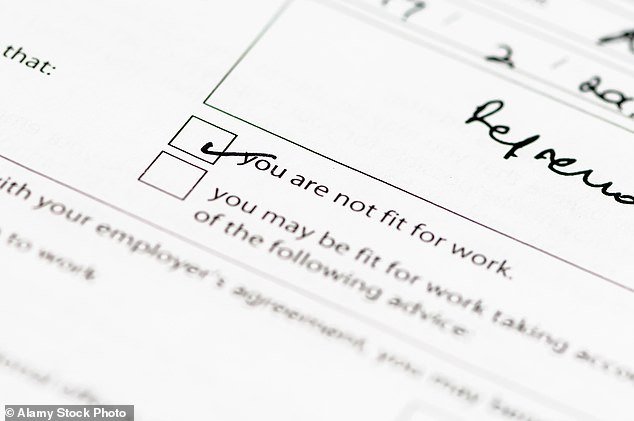
Also known as a ‘fit note’, the certificates are provided when someone is deemed unfit to work after they have been off for more than seven days.
Doctors, nurses, pharmacists, physiotherapists and GPs can all provide the notes, which inform an employer that the person is unable to carry out their job – or in some cases that adjustments should be made to support their return to the workplace.
But earlier this year hundreds of GPs confessed they had never denied a patient a mental health-related sick note.

More than 11 million sick notes were issued in England last year, newly released figures show
Sick notes issued for mental health conditions were more than double the number attributed to ‘diseases of the musculoskeletal system and connective tissue’ – including osteoarthritis, arthritis, gout, lupus and fibromyalgia – which accounted for 468,010 notes.
There was a small drop from the previous year – with the figure down by 41,395 – however there was also a 124,140-figure rise in notes handed out with the cause ‘not provided’- marking a 10.8 per cent change over the three years since 2022.
The biggest increase in people being signed off work since 2022 was for ‘congenital malformations, deformations and chromosomal abnormalities’, which rose by more than 17 per cent from 12,162 to 14,338.
The category includes inherited or developmental conditions such as Down syndrome and other disorders that may be linked to consanguineous relationships, such as cousin marriage.
There were also 156,422 cases in which people were signed off work with ‘diseases of the respiratory system’, a category that includes conditions such as pneumonia and chronic obstructive pulmonary disease (COPD) – a 14.53 per cent rise since 2022.
It comes as more than 5,000 GPs in England were questioned last month over whether they had ever denied a patient a sick note.
Just 752 responded to the BBC, with 540 saying they had never refused a request asking for a sick note linked to mental health.
Meanwhile, 162 said they had refused at least one person a fit note, with 50 not wanting to disclose a response.
Leading the nation for the number of sick notes issued last year was NHS North East London Integrated Care Board (ICB), which provided 454,757 of the notes.
That was an increase of just under 20 per cent since 2022.
Following them was NHS North West London ICB, which issued 390,467 fit notes in 2025 – up more than 18 per cent since 2022.
NHS Birmingham and Solihull Integrated Care Board issued 369,300 sick notes last year, while NHS South East London Integrated Care Board handed 343,803 certificates to patients.
The ICB to record the biggest increase of sick notes since 2022 was NHS Central East, where the number issued increased by more than 20 per cent over from January 2022 to December 2025.
More than eight million of the 11,171,899 certificates issued failing to carry a recorded diagnosis, meaning the true number of cases linked to specific conditions could be significantly higher than the newly published figures suggest.
Overall, the number of sick notes issued last year decreased slightly from 2024, when 11,181,103 notes were written.
Last July, Healthy Secretary Wes Streeting vowed to tackle the sick note epidemic, admitting ‘we simply cannot afford to keep writing people off’.
Mr Streeting said: ‘Some 2.8million people are out of work due to health conditions – this is bad for patients, bad for the NHS and bad for the economy.’
Earlier in the year official forecasts predicted the annual bill for Personal Independence Payment (PIP) would jump from £25.9billion when Labour came to office to a staggering £44.9billion by the end of the decade.
Paying for the increase alone would cost the equivalent of putting 2p on all income tax rates.
Last year, Keir Starmer abandoned plans to try to curb the growth of PIP payments following a revolt by Labour backbenchers.
Government sources confirmed that, despite ministers paying lip service to the need for welfare reform, there would be no legislation on the issue in the next King’s Speech in May.
The figures bolstered concerns that Labour is incapable of reining in rapid rises in welfare spending, which experts warn are unsustainable.
A Department for Work and Pensions spokesperson said: ‘There was little change in the number of fit notes issued in 2024 and 2025, and comparisons with 2015 are ill-advised due to significant differences in how the data was collected.
‘That being said, we have been clear the current fit note system needs reforming to work better for patients, employers and our health system. We are already testing new approaches as part of our wider plan to get Britain working, but we know that we need to do more to build a system that works for everyone.’
NHS England and the Department of Health and Social Care declined to respond.
