


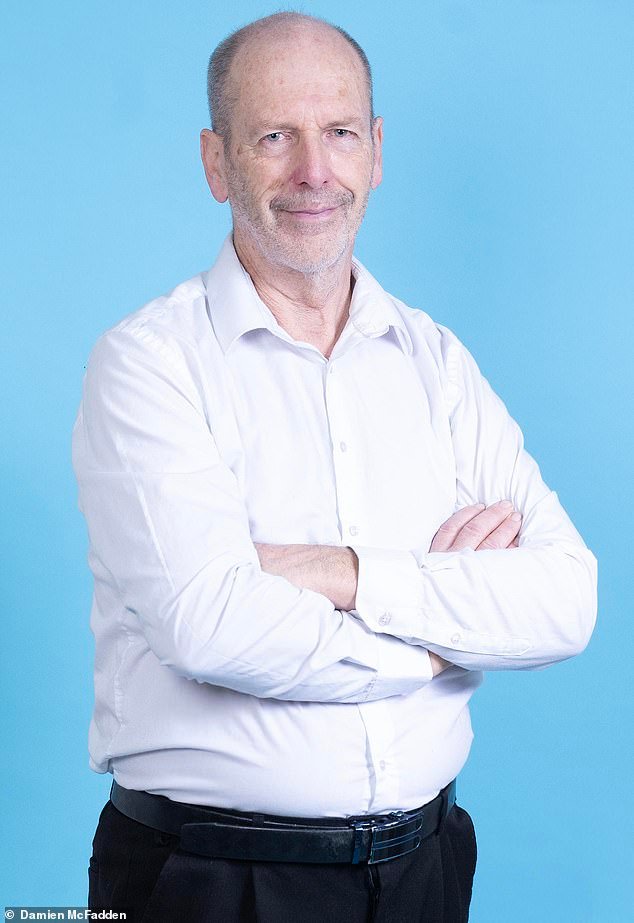
The mantelpiece of retired maths teacher Clive Jones’ home is crammed with family snaps of his three children and nine grandchildren – but this, he says, represents only a fraction of his offspring.
For Clive, 70, is a sperm donor – and a prolific one at that.
Over the past 12 years he has, he claims, fathered 168 children as a donor, having toured the country in his estate car to donate his sperm to women for free.
But what would motivate a man who has his own children and happy home life (his marriage has only recently broken down) to do this – and what would motivate women to choose him?
For it might be free in his case – typically others may charge a fee – but such unregulated sperm donation is fraught with medical and legal danger.
For example, sperm donated at authorised clinics is screened for disease and infection. But for Clive or the other men who set themselves up, usually via social media accounts to ‘advertise’ their services as a donor, there are no such checks.
And for the donors, it is a legal minefield. As we shall hear, the mothers of children born by donated sperm may be able to argue for maintenance, and there are other practicalities, too.
‘Some people think what I do is odd or weird,’ admits Clive. ‘But I only see the joy. So many people want children and can’t afford expensive clinics or long IVF waits.’
A surprising number of women seem to be willing to ignore the risks.

Clive Jones is 70 – and a prolific sperm donor. Over the past 12 years, he has fathered 168 children up and down the country

In 2022, he appeared in a segment on ITV’s This Morning. Clive was inspired to start donating after reading a newspaper report in 2014
Earlier this week the High Court threw out the case of Robert Albon, a sperm donor who says he has fathered 180 children worldwide, who wanted to be named as a father on the birth certificate of a child he donated the sperm for.
Last year, Jonathan Furness KC, sitting as a deputy High Court judge, named Albon, who lives in the North East of England, in order to warn vulnerable women considering buying sperm from him.
It was reading a newspaper report in 2014 about another sperm donor that inspired Clive – then in his late-50s – to investigate whether he could offer his own services.
‘Some donors, it seemed, just wanted to have sex with people,’ says Clive. ‘That was definitely not for me,’ he says. ‘I just wanted to help people get pregnant.’
Clive discussed his idea with his wife, who was initially ‘not happy’ at the idea but he was adamant.
The couple have recently separated, but Clive told the Daily Mail they remain on good terms, and it had nothing to do with his sperm donations.
Clive’s first step was joining a UK sperm donor Facebook group, where women wanting to be mothers put requests out for donors.
‘In the group, you have your profile picture and explain a bit about yourself,’ he says. ‘People will post that they want a particular donor on a particular day and the donor replies.’
Clive highlighted on his profile that he was tall, fit, active, had no health concerns and that he was degree educated, plus that he had fathered children successfully.
He got his first request within days of posting his profile, from an address not far from his home in Tamworth, Staffordshire.
This message, 12 years ago, would lead to Clive having his first donor child aged 58.
And it became the first of many.
Of the women he has helped have a baby, Clive says: ‘Some were same-sex couples; some were married but their husband couldn’t father a child; some were single.’
The donor sperm is handed over in a syringe. His only proviso is that the women use an ‘ovulation kit test, so we know they are ovulating and at their most fertile point of the month – as I don’t want to waste anyone’s time,’ says Clive. ‘Obviously it’s disappointing if it doesn’t work out.’

Unregulated sperm donation is fraught with medical dangers, such as the transmission of infection or lack of genetic screening and there is little legal protection for informal donors

Earlier this week, the High Court threw out the case of Robert Albon, who says he has fathered 180 children, who wanted to be named on a child’s birth certificate he donated the sperm for
In some cases, Clive has been contacted by women he helped become mothers who want him to father siblings so that their children are blood relatives.
‘One lady has five of my children,’ he says.
The Daily Mail has verified with some of these women that he has fathered children by donation, although we can only rely on his account for the number.
Clive’s desire ‘to help others’ may sound heartfelt, but unregulated sperm donation outside of the rules determined by the UK fertility regulator, the Human Fertilisation and Embryology Authority (HFEA), raises ethical and health concerns, say experts.
‘The first obvious danger with unregulated sperm donation is transmission of infection,’ says Dr Rowland Rees, a consultant andrologist at the Cleveland Clinic London.
‘Someone who is just receiving donor sperm does not know if the man has a sexually transmitted or genitourinary infection, such as chlamydia, gonorrhoea or other more serious diseases such as syphilis,’ he says.
Regulated clinics will normally screen men for HIV, hepatitis, syphilis or chlamydia, for example – as these infections could be transmitted to the mother, ‘and also cause risk to the baby as they can be passed on during pregnancy’, adds Dr Ravina Bhanot, a GP specialising in women’s health at Barts Health NHS Trust in London.
‘This can increase risk of miscarriage and congenitally abnormal babies.’
Dr Rees adds: ‘Clinics will also conduct genetic screening for serious conditions that can be passed through families, such as cystic fibrosis, and will take a medical history so they can check for cardiovascular disease or a strong history of cancer, for example.’
As a further safeguard, donor sperm is ‘washed’ at clinics, says Dr Bhanot, ‘to separate mobile sperm from debris or fluid’ and ‘help concentrate the best-quality sperm’.
‘NHS guidance suggests labs should routinely prepare and wash samples for treatment.’
Clinics also enforce a strict age policy – according to the NHS, the age range for donating sperm in regulated clinics is between 18 and 45.
‘It’s not just female fertility that declines with age, so does male,’ says Dr Bhanot.

Dr Rowland Rees, a consultant andrologist, says unregulated donation ‘raises the risk of a large network of genetic half-siblings and accidental relationships between half-siblings’

‘I do it purely to see the joy on people’s faces when they get their biggest dream – a child,’ says Clive – adding that while he is aware of the risks, he has no plans to stop
‘Older men have higher mutations in their sperm. There has been some association with older men and an increased risk of autism, schizophrenia and miscarriage.
‘Older men can still have healthy children, but the risks are just higher.’
And prolific, unregulated sperm donors such as Clive raise other deeply worrying problems.
‘It raises the risk of a large network of genetic half-siblings and accidental relationships between half-siblings,’ says Dr Rees.
That’s why HFEA says no donor should contribute to more than ten families, although there is no limit on how many children per family the donor can create.
Dr Rees adds that there is the future psychological impact on the child.
‘What’s beyond the medical problems are the psychological problems – once you find out you are the result of a donor and you have 170 brothers and sisters that can be traumatic.’
Clive says that he has thought about this – and some of the women he has donated to have started an online group so they can find each other, to avoid this happening.
There are considerations for the donors, too.
As the law stands, once a sperm donor-conceived child reaches the age of 18, they are legally entitled to find their donor.
If someone donated after April 1, 2005, the donor child is able to ask the full name and address at time of donation, centre where they donated and any other information held by the HFEA.
And Natalie Gamble, a fertility and surrogacy lawyer at NGA Law in London, says there is little legal protection for informal sperm donors.
‘In many cases the donor is the legal father, which means potential maintenance payments and claims against his estate if he dies,’ she told the Daily Mail.
And what the mother may not appreciate is that the donor ‘may be able to seek involvement with the child, which can lead to lengthy court battles.
‘In practice, if conceiving through known donation, we would recommend going slowly, talking in detail about what you each expect and putting things in writing in an agreement – even if it is non-binding – to avoid future legal disputes.’
But as using donor sperm from a regulated clinic can cost anything from £850 to more than £1,500, it is understandable that some might opt for the cheaper, albeit unregulated, option.
‘I have never asked for money and never will,’ says Clive.
Following a birth, he sends the mothers ‘a gift such as flowers’ – but then has ‘no contact’ unless the family or child wish it.
‘Some of them send pictures of the child as they grow, others don’t,’ he says. ‘That’s their choice. I don’t mind if they ask about me or if they want to know nothing. I am just the donor.’
Clive says he is aware of all the concerns, but chooses to continue doing what he does.
‘Private IVF and sperm banks are so expensive – and with so many hoops to jump through, is it any wonder people cannot afford to go the “correct” route and use a screened donor from a clinic? Not everyone has the means to do this,’ he says.
‘I always tell people my medical background – I have never slept with anyone except my wife, so have no sexually transmitted infections, and have no genetic diseases. Based on my health and the health of my own children, I know we’re healthy.
‘In an ideal world these people would be meeting people and having babies, but that is not what is happening. I am just offering a service to them.’
Clare Ettinghausen, director of strategy and corporate affairs at the HFEA, says: ‘It is always safer to have treatment at a licensed clinic. Unregulated or private sperm donation has serious risks for the patient, donor and any children born. ’
Clive has no plans to stop donating sperm.
‘I do it purely to see the joy on people’s faces when they get their biggest dream – a child.’
