


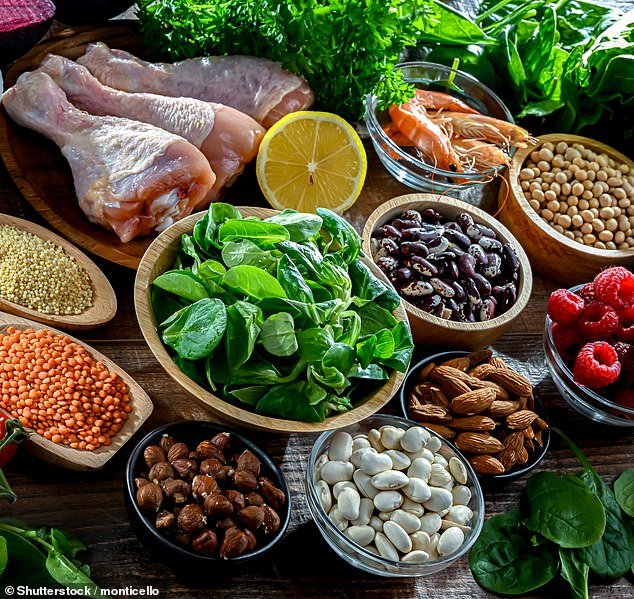
When doing our weekly shop, very few of us will consider if the food in our trolley could be quietly influencing our risk of dementia.
Studies have shown that most people would do almost anything to reduce our chances of developing the debilitating condition, but what if what we ate could help to stave off the disease?
Research published earlier this year found that people who adhered to a version of the Mediterranean diet – centred around dark leafy greens, wholegrains, fish, poultry and olive oil – were able to delay brain aging by around two-and-a-half years.
Earlier research found that the eating plan could slash the risk of Alzheimer’s by an impressive 53 per cent – even when adopted later in life.
With this in mind, registered dietician Pamela Nisevich-Bede believes there are certain foods everyone should be adding to their diet to boost their brain health – and they’re all readily available at the local supermarket.
She tells the Daily Mail: ‘Just as we think about a “best plate” for heart or metabolic health, we can also build one for brain health.
‘Start by prioritising foods that work hard for your health – non-starchy vegetables, lean proteins, deeply coloured fruits, nuts and seeds.’
Read on to find out what you should be piling high… and what needs to be left off your plate.

A diet rich in leafy green vegetables, berries, nuts, olive oil and fish could slow down age-related brain decline by more than two-and-a-half-years, experts say

Everyone experiences dementia differently. Use this checklist to help you make a note of your symptoms before you talk to your GP.
The diet that’s proven to slash your risk of dementia
Dubbed the MIND diet, short for Mediterranean-DASH Intervention for Neurodegenerative Delay – scientists believe eating a diet high in leafy green vegetables, berries, nuts, olive oil and fish could help delay dementia onset.
Around 900,000 people in the UK are currently living with dementia, a figure expected to rise to more than 1.6 million by 2040. It is the leading cause of death, accounting for more than 74,000 deaths each year.
The MIND diet was developed by researchers at Rush University and the Harvard Chan School of Public Health, it combines elements of the Mediterranean and DASH (Dietary Approaches to Stop Hypertension) diets.
It focuses on foods that research suggests help preserve brain function.
‘These foods also support healthy glucose levels, which are closely linked to focus, cognition and long-term brain health,’ says Nisevich-Bede.
In the first analysis of its benefits, published in the journal Alzheimer’s & Dementia in 2015, more than 900 participants were monitored for an average of four-and-a-half years. Those who adhered to the diet most strictly reduced their risk by 53 per cent.
Subsequent research has produced similar results, with a 2023 review of previous studies, published in JAMA Psychiatry, involving 224,000 middle-aged participants, showing that those who stuck closely to MIND principles were 17 per cent less likely to develop dementia than those who didn’t.
The benefits are thought to be due to the anti-inflammatory properties of the foods recommended and their ability to help reduce oxidative stress (a build-up of harmful molecules called free radicals).
Both are thought to play important roles in brain ageing and neurodegenerative diseases.
Just four days of junk food can impact your brain health
‘I’m a big believer in adding foods, rather than restricting them,’ Nisevich-Bede says.
However, some foods do need to be restricted – or avoided as much as possible.
Ultra-processed foods (UPFs), such as supermarket loaves, fried foods and ready-meals already make up a worrying percentage of every day diets.
The worry is these foods aren’t just high in fat, they’re also extremely high in salt, which can push up blood pressure and disrupt memory pathways in the brain, and sugar which can increase the likelihood of type 2 diabetes.
‘Diets high in fried foods, sugary snacks and drinks and those high in salt are linked to inflammation, oxidative stress, high blood pressure and insulin resistance – all factors associated with cognitive decline and increased dementia risk,’ Nisevich-Bede explains.
Brain boosting foods
These are the ten brain-healthy foods set out in the MIND diet, proven to reduce dementia risk…
- LEAFY GREENS such as spinach, kale and other vegetables rich in folate and vitamin K: six-plus servings a week.
- OTHER VEGETABLES, particularly colourful varieties: one-plus serving daily.
- NUTS, especially almonds and walnuts for healthy fats: five-plus servings a week.
- BERRIES like blueberries and strawberries, rich in antioxidants: two-plus servings a week.

Olive oil is recommended for cooking as part of the MIND diet
- BEANS AND LEGUMES for protein and fibre: three-plus servings a week.
- WHOLEGRAINS – brown rice, quinoa and whole wheat products: three-plus servings a day.
- FISH – fatty fish (e.g. salmon, mackerel) for omega-3 fatty acids: one-plus serving weekly.
- POULTRY – this is a good, lean protein source: two-plus servings a week.
- RED WINE in moderation; one glass daily (this is optional).
And the five categories of food considered unhealthy are: red meat; butter and margarine; cheese; pastries and sweets as well as fried or fast foods.
One serving (or less) per week of these foods are recommended.
Over time, high blood pressure – medically known as hypertension – can damage blood vessels, including those leading to the brain.
This can restrict blood flow, ultimately resulting in vascular dementia – the second most common type of the condition after Alzheimer’s.
Fried foods in particular are typically high in trans fats. These are artificial fats, made by adding hydrogen to vegetable oils to give foods like margarine a longer shelf life.

Like saturated dats, artificial trans fats can raise levels of bad cholesterol and spike blood sugar levels, Nisevich-Bede says, both of which promote inflammation in the brain.
‘While you might choose these foods occasionally, it’s the chronic and frequent consumption that evidence ties to risk of neurodegeneration,’ she notes.
‘And the connection between obesity, insulin resistance, and dementia risk is concerning.’
How does sugar influence dementia risk?
Spikes and crashes in blood sugar levels are typically associated with a post-lunch slump, and over longer periods, increased risk of chronic health conditions like type 2 diabetes and heart disease.
But now, emerging evidence suggests the pattern could also be bad for your brain.
‘Sugar itself isn’t the issue,’ Nisevich-Bede explains. ‘It’s frequent, large glucose spikes.’
Research from more than 350,000 people in the UK suggest that those who are prone to sharp post-meal spikes have a significantly higher risk of Alzheimer’s – even if they don’t have diabetes.
‘This has lead to Alzheimer’s sometimes being referred to as type 3 diabetes, because insulin resistance plays a central role in the disease,’ Nisevich-Bede says.
‘When brain cells become insulin resistant, they struggle to take up and use glucose efficiently. That impairs brain function over time and may accelerate cognitive damage.
‘This is why consistently high blood sugar levels are seen as a risk factor for cognitive decline.’
Join the discussion
Do YOU believe diet plays a major role in preventing dementia?
It doesn’t necessarily have to be a bag of sweets of bar of chocolate causing the spikes.
Through her own research, Nisevich-Bede discovered that her mental fogginess and afternoon slumps were linked to eating ‘healthy’ foods.
‘For years, I’d eat lunches like porridge or a sandwich and feel foggy and exhausted a few hours later,’ she says.
‘I assumed it was long working hours or poor sleep, but when I finally looked at my glucose data, the pattern was obvious: my glucose would spike and then crash, and my energy and focus followed the same rollercoaster.’
To prevent the inevitable lulls, she tweaked how she ate complex carbohydrates, taking extra care to pair them with other foods that would slow down their absorption.
It was a tiny, easy switch that has had hugely positive repercussions.
‘Now I build every meal and snack with protein and fibre first, and I’m mindful of food order,’ she says.
‘I still eat carbohydrates, but I pair them with other nutrients and often eat them last.
‘That simple shift helps keep my glucose steadier, which translates into more consistent energy, sharper focus and better day-to-day brain performance.’
Is cheese a brain staple or occasional treat?
Spread on crackers, melted over baked beans, or grated generously over pasta, we are a nation of cheese lovers.
But sadly for cheese fiends, due to its high fat content, experts have long warned to only enjoy it as an occasional treat – or, if you’re really worried about your heart health, avoid it altogether.
Typically high in saturated fat, cheese has been linked to high levels of ‘bad’ cholesterol which increases the risk of heart disease, type 2 diabetes and stroke.
As such, the NHS recommends eating no more than 30g a day, with a small matchbox-sized slice of cheese containing around 7g of saturated fat.
However, the evidence regarding cheese intake and brain health paints a different picture.
Publishing their findings in the journal Neurology, Swedish researchers – who monitored the eating habits of over 27,000 middle-aged adults – found those who regularly ate cheese or high fat cream were less likely to develop dementia.
People who added around a tablespoon of cream to their porridge or coffee had a 16 per cent lower risk of dementia than those who consumed none – challenging long-held assumptions about fat and brain health.
Red meat can be beneficial… unless you have the so-called ‘dementia gene’
Last year, world-leading experts demanded a ban on supermarket bacon and ham, after regular consumption was linked to more than 50,000 bowel cancer cases.
But it’s not just bowel cancer we need to be wary off. Too much processed red meat may also hamper our future brain health, experts say.
‘There’s a lot of confusion around red meat and dementia risk, largely because not all red meat is the same,’ Nisevich-Bede explains.
‘The evidence is more consistent for processed red meat, such as bacon and sausages, which has been linked to an increase risk of dementia – likely because they contain nitrates and nitrites, high salt levels and preservatives, all of which can promote inflammation and damage blood vessels that supply the brain.’
But new research has suggested that increasing your meat intake in mid-life could actually help protect against the memory-robbing condition.
That is, if you carry the ‘Alzheimer’s gene’.
The gene, known as APOE, has long been linked to Alzheimer’s, and is said to be linked to more than 90 per cent of cases of the disease.
But researchers at Stockholm university found that higher meat intake in midlife was associate with slower cognitive decline among those with the gene.
Those who ate the most meat had a 45 per cent lower risk of dementia than those eating the least – suggesting meat isn’t all bad when it comes to brain health.
One reason for this, Nisevich-Bede says, could be because fresh red meat is high in iron, vitamin B12 and zinc, which are actually all really important for brain function.
‘My advice is moderation and variety is key; you don’t need to cut our red meat entirely, but reducing processed meat and diversifying protein sources, with oily fish, legumes and poultry is a sensible approach.’
The NHS recommends limiting red or processed meat intake to no more than 70g a day – the equivalent of two rashers of bacon – if you currently eat over 90g.
