


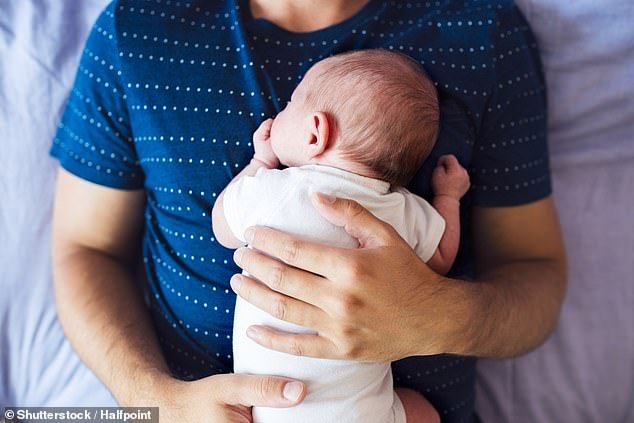
The number of single men becoming fathers via surrogacy has tripled – with more than 100 men now pursuing parenthood on their own, official figures have revealed.
As of last year, 170 men in England have submitted applications to become the legal parent of a surrogate baby between 2019 and 2025.
According to the Children and Family Court Advisory and Support Service (Cafcass), numbers have been rising since the law giving single people the same surrogacy rights as couples was changed in 2019.
The data shows 36 men made sole applications in 2025 alone, with parental order applications for foreign-born surrogate babies now dominating cases.
But campaigners say the data, released under freedom of information laws, reflects a worrying trend.
Helen Gibson, founder of campaign group Surrogacy Concern, said: ‘The growth in the numbers of single men pursuing surrogacy should alarm us all.
‘Children’s needs are best served remaining with their birth mothers; this is especially important for newborn babies who bond with their mothers in utero, regardless of the egg used in pregnancy.
‘At birth, babies want and need only their mothers; separation is cruel.

The number of single men applying for parental orders has tripled in four years
‘Mothers are the primary safeguarders of their children: removing babies from their mothers and handing them over to the sole care of lone men should not be happening,’ she added.
‘We understand why those who cannot have children wish to do so, but this should not be a route open to single men.
‘It’s high time this entire industry was banned completely, regardless of sex or sexuality.’
Anti-surrogacy campaigners continue to call on the Government to implement a blanket ban, arguing that the practice ‘exploits the poverty of low-income women,’ and subjects them to high risk pregnancies.
But, overall, figures show the number of single men applying for parental rights of a child born through surrogacy is still low.
Sarah Jones, chief executive of SurrogacyUK, said: ‘While we want to be clear that solo parents are warmly welcomed, this is certainly not a trend. The overwhelming majority of our members continue to be couples.’
In 2019, when the law was changed, there were 29 initial applications from single men, but this dropped to just 12 the following year.
In total, there were 2,022 applications for parental orders between 2020 and 2024 – made by couples and single men and women.
However, what the figures do reflect is a growing trend of having children as a single parent – either through IVF or surrogacy.
Naomi Campbell, 55, is just one of a growing number of celebrities who have used surrogacy to pursue their dreams of having a child, becoming a mother in 2021.
She now has two children via surrogacy as a single mother.
Nicole Kidman, Rebel Wilson and Lily Collins have all also used surrogates, splitting reaction along predictable lines: those in favour of surrogacy and those against it, with many taking issue with possible motives to use a surrogate.

Lily Collins became a first-time mother after welcoming a child via surrogacy in January 2025
Debate has centred on the motives of women who choose to become surrogates – which can be a lucrative income in the US – and the moral reasoning for growing your family using another woman’s womb.
The fiercest arguments centre on the difference between turning to a surrogate in the case of fertility issues, and a woman deciding to use a surrogate to maintain her figure or simply because she is rich enough to outsource the physical labour of carrying a child.
People are also divided on the motives of the surrogate.
It was also revealed last year there has been a concerning rise in the number of people aged 80 and over using surrogates to become parents later in life – sparking furious backlash from anti-surrogacy campaigners.
The data showed an upward trend in applications made by men in their fifties, with 44 in 2020 and 95 in 2025.

Anti-surrogacy campaigners want an age limit placed on people who can use surrogacy
At the time, Gibson said: ‘We are appalled to see parental order applications for surrogate-born babies being made by people in their sixties, seventies and eighties — there can be no justification for such a selfish act.
‘It even more concerning to see that these figures are consistently rising year by year.’
Surrogacy is currently legal in the UK, but the law prevents commercial arrangements, meaning it is illegal to advertise for a surrogate mother or pay more than ‘reasonable expenses’ for her help.
In the UK, which has an ‘altruistic’ system, this is considered between £12,000 to £15,000.
Under British law, the surrogate mother is treated as the legal mother at birth and any husband or partner she has as the father.
Those in surrogacy arrangements can apply to a court within six months of the child’s birth for a ‘parental order’ to acquire parenthood.
These extinguish the status of the surrogate mother and grant parental status to the couple. A new birth certificate can then be issued.
