

When it comes to the vitamin alphabet, people usually lose interest by the time they get to ‘E’ – but there’s one that really shouldn’t be overlooked.
Vitamin K, which is found in green leafy vegetables, vegetable oils, grains, and in some meats and cheeses, is vital for scores of bodily functions from wound healing to bone regeneration to keeping blood pressure down.
It does the latter by preventing calcium from being deposited on the walls of arteries and other major blood vessels, reducing vascular stiffness and keeping things moving smoothly.
And while the NHS guidelines state that most people can get all of the vitamin they need from food, it’s possible to buy supplements for just 3 pence a pill.
Jan Olav Aaseth, a professor at the University of Inland Norway, says the removed calcium goes straight into our bones, effectively making Vitamin K doubly useful.
‘Vitamin K is necessary for carrying calcium away from the heart and blood vessels into bone, thereby improving both heart and bone health,’ he told The Telegraph.
And while it might seem like you’d need to be taking a fistful of Vitamin K supplements every day to keep your arteries clear and supple, he’s adamant that you can get all you need from your diet – if you eat enough vegetables.
‘The problem is that modern diets might contain two small amounts of vegetables [per day], for instance, broccoli, that contain Vitamin K,’ he explained.

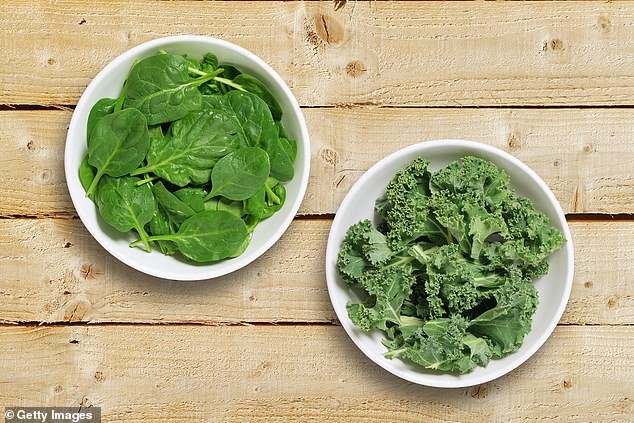
Leafy greens such as spinach and kale have been found to be especially rich in vitamin K1
Upping your Vitamin K level isn’t just going to help your blood flow more smoothly, it’s been linked to a swathe of beneficial health outcomes.
Speaking to the Daily Mail, Professor Penny Ward, a pharmaceutical expert based out of King’s College London, said that new studies have positioned it as a tool to stave off dementia.
She said: ‘Observational studies suggest that adults eating a diet rich in vitamin K live longer and are less likely to develop heart disease or dementia.’
Ms Ward added that this is because Vitamin K can help ‘preserve normal brain function by preventing brain cell death’ and assists with clearing toxic amyloid proteins from the brain.
Earlier this year, researchers found that following the MIND diet could reduce people’s Alzheimer’s risk by more than half – and Vitamin K-rich foods feature heavily on the menu.
The MIND diet – which stands for Mediterranean-DASH Intervention for Neurodegenerative Delay diet – was developed by researchers at Rush University and the Harvard Chan School of Public Health, and combines elements of the Mediterranean and DASH (Dietary Approaches to Stop Hypertension) diets, focusing on foods that research suggests help preserve brain function.
In the first analysis of its benefits, published in the journal Alzheimer’s & Dementia in 2015, more than 900 participants were monitored for an average of four-and-a-half years. Those who adhered to the diet most strictly reduced their risk by 53 per cent.
But that’s not the only way that Vitamin K can boost your health.
Ms Ward said: ‘General health benefits include a reduction in inflammatory proteins and improvement in insulin sensitivity which may reduce the risk of type 2 diabetes.
‘Vitamin K has a beneficial effect on a variety of body proteins which help to preserve healthy bone mass and, importantly, prevent the build up of calcium deposits in arteries which can lead to heart attacks and strokes.’
But what exactly is Vitamin K – and how can we make sure we are getting enough of it?
A fat-soluble vitamin – which means it can be stored by the body – it exists in two forms: Vitamin K1 and Vitamin K2.
Vitamin K1 is found mainly in leafy green vegetables – Brussels sprouts, broccoli, asparagus and green cabbage – while Vitamin K2 comes from fermented foods and animal products like eggs, chicken liver and chicken thighs.
It is also found in dairy products such as full-fat milk, yoghurt and cheeses including gouda, edam, brie, camembert and roquefort.
Interestingly, they are beneficial in different ways. Research suggests that Vitamin K1 plays a greater role in targeting blood clotting, while Vitamin K2 may be more effective at helping the body direct calcium away from the arteries.
The NHS says most people should be able to get enough Vitamin K through a balanced diet, with adults needing a daily dose that is roughly one microgram per kilogram of body weight.
Supplements are also sold online and in wellness shops, split by Vitamin K1 and Vitamin K2, but Ms Ward says getting the vitamin into a diet through food is so ‘easily achieved’ there is generally ‘no need’ to buy supplements.
However, deficiencies do happen. Low levels of Vitamin K have been linked to a range of health problems, including bleeding disorders, poor bone development and cardiovascular disease.
Stefanos Roumeliotis, a kidney specialist at Aristotle University of Thessaloniki, also told The Telegraph that ’96 per cent of chronic kidney disease patients are severely deficient in Vitamin K.’
But before you stock up on kale (or supplements), the NHS urges caution.
They say supplementing under 1 milligram of Vitamin K is unlikely to cause harm, but people on blood thinning medications should avoid them due to potentially harmful interactions.
This is because warfarin – a common drug used to treat blood clots – blocks the body’s use of the vitamin.
Normal dietary intake of Vitamin K can usually be maintained while taking warfarin, but sudden or significant increases in consumption should be avoided.
Ms Ward said: ‘People taking the anticoagulant warfarin should not change their Vitamin K intake without consulting their doctor as it counteracts the effects of warfarin on blood clotting.
‘But direct acting anticoagulants – apixaban, rivaroxaban or dabigatran – will not be affected as these drugs do not interact with Vitamin K.’
