

Spring should be the season of long walks, blooming flowers and more time outdoors.
But for more than 100 million Americans, it also marks the start of months of relentless sneezing, coughing and runny noses.
Now, a new report has revealed the worst-hit cities in America, with one unexpected location taking top spot as the nation’s allergy capital.
In its latest annual rankings, the Asthma and Allergy Foundation of America analyzed the pollen data for America’s 100 most populous cities to reveal the 20 where conditions would pose the biggest risk to those with allergies.
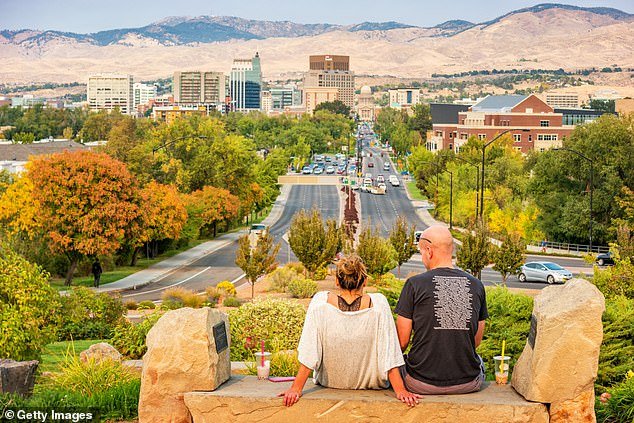
Boise, Idaho, was named the worst city for pollen allergy sufferers — the first time it has taken the title since the report began in 2003.
Rocketing from 95th place in last year’s report, analysts said it had surged in the rankings because levels of tree, grass and weed pollen had spiked in the area over the last 12 months and have been present for longer than normal. They also noted it had too few allergy specialists for its population.
San Diego, California, took second place, surging from 97th last year owing to the same shifts, while Tulsa, Oklahoma, came third, about where it was last year.
Overall, 12 of the 20 worst-affected cities were new entries to the top rankings in this year’s report, with Wichita City, Kansas, which has held the top spot for three years in a row, dropping down to sixth place.

Boise, Idaho (pictured above), was named the nation’s pollen capital in the annual allergy report
Analysts said the shift was driven by heavy rainfall and long-lasting warm weather over the past 12 months, which had driven up pollen counts in many areas that previously had lower levels.
The rainfall leads to more plant growth, and therefore more pollen being released, while warmer weather means that pollen is released for longer every year.
To avoid allergies, experts recommend sufferers should track pollen levels and not go outside when these are at high levels. They also recommend shutting windows and doors to lock pollen outside, and using air-conditioning to lower levels.
In cases where someone must go outside into the pollen, however, they have several suggestions for how to reduce symptoms.
This includes taking allergy medications before exposure, to help calm symptoms, wearing sunglasses and a face mask, to avoid contact with pollen, and washing as soon as they return inside, to avoid bringing pollen into the house.
Amid escalating pollen levels, estimates suggest that more people than ever are suffering from allergies — and needing to take these precautions.
Sanaz Eftekhari, the vice president of the organization behind the report, warned: ‘Climate change is driving some areas to have a nearly year-round cycle of pollen production or experience major pollen explosions multiple times a year due to extreme weather.
‘These longer and more intense pollen seasons mean allergy symptoms may start earlier, last longer, and be more difficult to control. This makes symptom management all the more important.’
In the report, researchers analyzed the level of tree, grass and weed pollen in the cities over the last 12 months, alongside the usage of over-the-counter allergy medications and the availability of board-certified immunologists, to give each city a score out of 100.
The cities were then ranked to reveal which was most likely to have the worst pollen levels for the coming spring and summer.
Boise was the only city to score 100 out of 100.
Rounding out the top five for the highest pollen levels were Provo, Utah, in fourth place and Rochester, New York, in fifth.
Previously, the top allergy cities have been concentrated in the Southeast, due to the area’s warmer and more humid climate that supports pollen production.
But in 2025, areas in the West had more spikes in pollen and a longer pollen season, particularly for grass and weed pollen, leading many to jump dramatically in the rankings.
This was due to the region having more extreme weather events, which drive more plant growth and a longer pollen season.
Overall, and amid the shifting conditions, 35 of the 100 cities in the report all reported worse average pollen levels in the 2026 report compared to the previous year.
At the other end of the scale, the five cities with the lowest pollen levels were Houston, Texas; New York, New York; San Antonio, Texas; Boston, Massachusetts; and Phoenix, Arizona.
Allergy season lasts from March to June every year, and affects about 25 percent of adults and 19 percent of children, the CDC estimates.
Symptoms include itchy and watery eyes, runny noses and relentless sneezing and coughing that start whenever someone is exposed to pollen.
Doctors may treat the condition using over-the-counter antihistamines and decongestants to relieve sneezing and blocked noses. There is no cure for allergies.
Other advice for people to avoid allergies includes washing any pets as soon as they come indoors, to avoid bringing pollen into the house.
Some experts recommend eating local honey to reduce symptoms, saying it may contain local allergens that helps the body adjust to pollen. Science, however, says there is little evidence to support this theory
Other remedies include a Himalayan salt lamp, which works by attracting moisture and airborne particles to clear the air, though experts are yet to reveal concrete scientific evidence to support this theory.
