


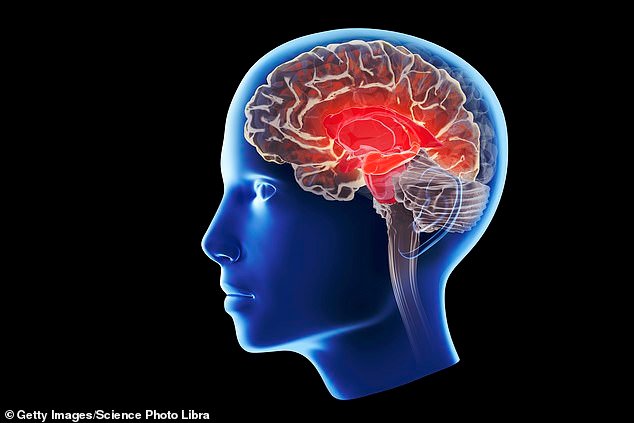
Despite hundreds of drug trials costing millions, a cure for dementia remains elusive. But have scientists been looking in the wrong place for a treatment to tackle this modern-day epidemic?
Recent evidence suggests the key to beating Britain’s biggest killer may not be a drug – but surgery.
And the operation is not a complex neurological procedure that requires risky access to the brain. Instead, it’s a relatively straightforward technique, which doctors liken to clearing a blocked drain, in order to flush out toxic proteins linked to dementia.
Called lymphaticovenous anastomosis (LVA), this type of treatment is already used on the NHS to help women with breast cancer who develop lymphoedema, swelling of the arms and legs due to a build-up of fluid.
The condition – which affects an estimated 400,000 people in the UK – develops when surgeons remove lymph nodes (tiny bean-shaped nodules that filter out waste products from the bloodstream) to stop cancer spreading.
Although it can be life-saving, removing the lymph nodes can lead to swelling in the limbs which makes everyday tasks, such as getting dressed, difficult.
With the LVA procedure, a tiny incision is made under the armpit, then surgeons stitch the lymph vessel that’s full of fluid to a nearby vein – allowing the excess fluid to drain into the bloodstream and get flushed out through the kidneys. The benefits are well-established, although the NHS tends to reserve the procedure for severe cases.
Now researchers are experimenting with a similar technique – attaching lymph vessels in the neck to veins – to treat dementia.

The key to beating dementia may not be a drug – but surgery. And the operation is not a complex neurological procedure that requires risky access to the brain – instead, it’s a relatively straightforward technique
The brain has its own lymphatic drainage system to dispose of waste. As we age, this system becomes sluggish, allowing harmful proteins in the waste fluid to accumulate in the brain.
These proteins can lead to the formation of deposits – amyloid plaques – which start to harm cognitive function, eventually leading to symptoms such as memory loss, confusion, language problems and personality changes.
Around 2,000 patients with dementia have so far undergone the procedure, with claims that in some cases they’re once again able to recognise loved ones and regain memories lost to the disease.
The surgery involves making a small incision in the neck just below the jaw. This accesses the deep cervical vein – which drains blood from the neck – where it runs parallel to a lymphatic vessel, which carries waste products from the brain.
A hole is then cut into the vein and the lymphatic vessel is stitched into place. Almost immediately, plaque-causing proteins start to drain away. The operation, which is done under general anaesthetic, takes a couple of hours.
‘It’s pretty much the same principle as that behind many of today’s newer drugs, which is basically to try and flush out the bad proteins,’ says Pat Kehoe, a professor of translational dementia research at the University of Bristol.
The drugs in question – lecanemab and donanemab – are designed to bind to the damaging proteins so they are transported out of the brain.
However, the drugs are not approved on the NHS due to their cost (up to £80,000 a year), limited benefits and side-effects, which include brain bleeds.
But the new surgical approach is controversial.
Almost all of the 2,000 or so procedures on dementia patients that have been carried out so far have been done in China, where – critics say – surgeons have been able to operate without first establishing that the procedure is even safe (let alone effective).
Although LVA for cancer-related lymphoedema carries little risk (there’s a small chance of infection or abnormal scarring), it’s not clear if operating on the neck is as safe.

Pat Kehoe, a professor of translational dementia research at the University of Bristol, warns that even if patients do benefit from the procedure, it’s almost certainly not a cure
In fact, the Chinese government became so concerned at the surge in these dementia operations that, in July 2025, it banned the procedure unless part of a research project.
Most of the evidence on whether it works comes from individual case reports or press releases from hospitals.
For example, in June last year, the Chinese PLA General Hospital in Beijing announced it had successfully performed LVA surgery on an 80-year-old woman who was previously unable to recognise her family members and relied on others for daily activities.
The hospital said: ‘She has shown significant improvements in memory. She can not only accurately say relatives’ names and occupations, but also engage in conversations.’
There have been two small studies that purport to show the surgery is effective.
One, at the Army Medical University in Chongqing, China, monitored 26 patients with Alzheimer’s who’d had the controversial operation.
One month later, according to results published in the International Journal of Surgery last year, all patients registered significant improvements on the Mini-Mental State Examination (MMSE), a questionnaire that measures cognitive decline generally by assessing memory, attention, language and orientation.
The second study, also published last year, by Zhengzhou University in China, involved 41 patients with mild to moderate Alzheimer’s.
Writing in the Journal of Alzheimer’s Disease Reports, researchers said that three months after surgery, there were similar improvements in MMSE scores, as well as in a test called Activities of Daily Living – a measure of how well dementia patients can manage simple everyday tasks such as bathing, dressing and eating.
However, the second study did not report on all the participants, so it’s not known how many improved.
Even if patients do benefit, it’s almost certainly not a cure, warns Professor Kehoe.
‘The likelihood is that the procedure only buys you time because all you’re doing is helping to flush out the system, while whatever is driving the production of those proteins is still happening,’ he says.
‘That said, if it slowed down progression of the disease by ten years or so, then that would be a huge benefit. But the proof of that will only come in proper, large-scale trials.’
He adds that an overstretched NHS would struggle to cope with all those needing the procedure (nearly one million people in the UK have Alzheimer’s).
Other experts are more scathing. Robert Howard, a professor of old-age psychiatry at University College London (UCL), says any apparent improvement is almost certainly due to wish fulfilment.
‘People with dementia are desperate to see some improvement and the placebo effect is very powerful,’ he told the Daily Mail. ‘There is no good evidence that surgery has any effect on amyloid plaques. I’ll only believe it is effective if and when there is evidence from proper clinical trials.’
Gill Livingston, a professor of psychiatry of older people at UCL, adds: ‘There is too little evidence that it works at all.’
Nevertheless, research teams outside of China are launching trials. In January, doctors in Singapore began recruiting ten patients with mild to moderate dementia to undergo the surgery. Results are due in 2030. And at Yale University in the US, there are plans to operate on five volunteers over the next few years.
