


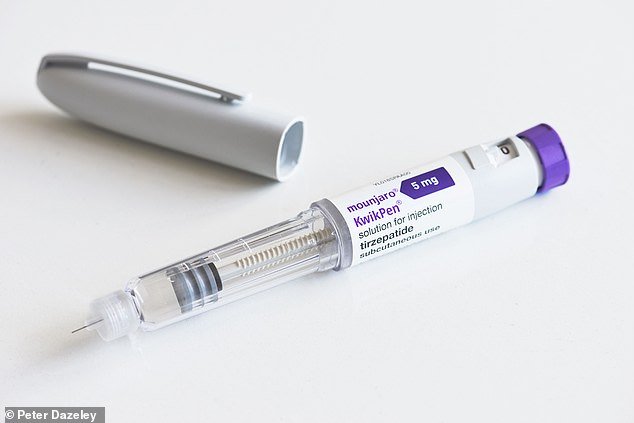
I’ve lost weight with Mounjaro injections. But I have bad nausea and my hair is falling out. Is there anything I can take for this?
Fiona Bagley, north-west London
Dr Martin Scurr replies: Mounjaro or tirzepatide (its generic name) is highly effective for diabetes and weight management, but it does have side-effects.
Nausea is very common, which is perhaps not surprising as it acts on the part of the brain that controls appetite – and also regulates nausea.
As tirzepatide slows down the rate at which the stomach empties, this can lead to a sense of fullness which can also contribute to nausea.
About 5 per cent of those taking Mounjaro or similar drugs report hair loss. This isn’t caused by the medication itself, but by the rapid weight loss.
Normally, a hair is shed (we lose between 30 and 150 every day) and a new one grows to replace it. Most of the follicles on the scalp are growing hair. The remainder are resting before they shed their hair.
However, when the body is placed under considerable stress, the balance shifts towards shedding, leading to considerable hair loss.
A serious illness, such as pneumonia, and the hormonal changes that occur on stopping breastfeeding, can also trigger this kind of hair loss.
The good news is that it is temporary: when you stop taking the weight-loss drug, the stress on your follicles will ease and hair growth will resume.
While there aren’t specific supplements proven to stimulate hair growth, it is possible that your reduced food intake means you are missing out on nutrients that support the health of the hair follicles.

Weight loss jabs, though highly effective, can lead to side effects such as nausea and hair loss

The good news is that it is temporary: when you stop taking the weight-loss drug, the stress on your follicles will ease and hair growth will resume
So, in this case, I suggest a supplement called Florisene may help you. This is available from pharmacies without a prescription and contains iron, selenium, lysine, vitamin C, and vitamin B12 – which are all required for healthy follicles.
In terms of your nausea, one natural remedy worth trying to ease this is ginger.
It contains compounds that affect receptors in the gut that can trigger nausea – it also has an anti-inflammatory effect that can help soothe an irritated gut.
Drink it as a tea using fresh ginger (although ginger teabags may be more convenient).
Bear in mind that ginger might interact with blood-thinning drugs, diabetes medications, and some blood-pressure agents. If in doubt, speak to your GP first.
Last year I suffered a major nosebleed and my left nostril was cauterised. My nose continued to bleed so I was given a nose clip to halt the blood flow. Is there any other way to cure these bleeds? I am 86.
Roger Needle, Oxfordshire.
Dr Martin Scurr replies: Recurrent nosebleeds (known medically as epistaxis) are often due to the interplay of several causes at your seniority.
Most bleeds are from the Little’s area, part of the septum where five arteries meet. With advancing age, the nasal lining in this already fragile area can become thinner, leaving the minute blood vessels more vulnerable.
This may be worsened by dry or heated environments which dry out the nasal lining making it even more vulnerable.
The repeated cauterisation (using heat to seal the blood vessels), while necessary, thins the nasal lining even more.
Certain medications can contribute to persistent bleeding, for instance blood-thinning drugs such as warfarin and anti-clotting drugs such as aspirin – though I am sure your doctors will have considered if this is relevant in your case.
Another potential factor is how well your blood clots, so it’s important you have a blood test to check for thrombocytopaenia (low platelet count) which will also screen for any abnormalities in blood clotting function.
If none of the above applies I recommend you sniff salt water from the palm of your hand, twice daily (or you can use Sterimar, or a similar spray product, available from pharmacies).
This prevents the nasal lining from drying out and cracking.
In my view… One-off therapy to replace statins
Reducing raised cholesterol can, for many people, be life-saving.
Left unchecked high levels of the ‘bad’ cholesterol, LDL, can fur the arteries and lead to heart attacks and strokes – the challenge for doctors is finding a medication that is sufficiently effective and has limited side-effects that patients will commit to taking for life.
There are options – statins, PCSK9 inhibitors (e.g. evolocumab), ezetimibe, inclisiran – but all have their drawbacks.
But could gene-editing therapy – a one-time treatment – improve on these options?
In a recent preliminary study, 15 patients were given an infusion of edited genes that turned off a protein (ANGPTL3) in the liver which regulates how LDL and triglycerides (another blood fat) are metabolised, reducing both by about 50 per cent.
While there were no serious adverse side-effects, we don’t know about the long-term results yet.
More research is needed, but watch this space.
- Write to Dr Scurr at Good Health, Daily Mail, 9 Derry Street, London, W8 5HY or email drmartin@dailymail.co.uk. Replies should be taken in a general context. Always consult your own GP with any health concerns.
