


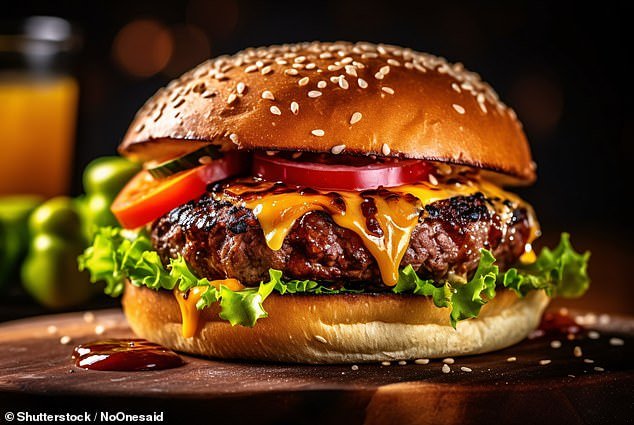
Few foods are as loved, universally, as a burger.
For some, they spark nostalgic memories of summer barbeques – for others, they no doubt make the perfect accompaniment to an ice-cold beer at the weekend.
Or they might just be something quick to grab from a drive through on the way home from work.
In fact, Americans consume an astonishing 50 billion burgers every year – equivalent to the average person eating nearly three burgers per week.
While not exactly considered a health food, dietitians say that they can be part of a balanced diet, particularly if you make them yourself.
Texas–based dietitian Whitney Stuart told the Daily Mail: ‘An occasional burger can be a healthy choice, as they’re a good source of protein and vital nutrients such as vitamin B12 – which is important for red blood cell formation, nerve function and keeping your body’s energy levels up.
‘You just need to watch out for the saturated fat in some types of ground beef and added extras like cheese and bacon.’
So what is the healthiest burger to buy and make at home? We spoke to the experts about what to look for, what to avoid… and the surprising ways to make your patty a nutritional powerhouse.

Which is the healthiest burger in the supermarket? We asked the experts (stock image)
For beef burgers, go 80% lean
For most, a burger patty just has to be beef. These, at their simplest, are made from ground beef. Recipes also incorporate ingredients like salt, pepper, onions, or binders to enhance taste and structure.
In terms of nutrition, ground beef is a rich source of high-quality protein, typically providing around 20 to 26 grams per 100g, depending on how lean the meat is – with leaner cuts containing slightly more protein by weight.
Different cuts, such as chuck, brisket, or round, contain varying levels of fat, which affects the flavor, juiciness, and texture of the final patty.
Beef fat is extremely energy dense, delivering around nine calories per gram – for comparison, pure sugar is around four calories per gram.
It is roughly 50 per cent saturated fat, which is the type linked to increased risk of heart disease.
However, the other 50 per cent is almost all monounsaturated fat – mostly oleic acid, which is the same heart‑healthy fat found abundantly in olive oil.
Grocery stores generally stock burgers that are anything from 25 percent to just seven percent fat.
Surprisingly, Stuart recommended looking for a burger that is around 20 percent fat.

Model Chrissy Teigen tucks into a burger while acting as a judge at the South Beach Wine and Food Festival in Florida. This picture was taken in 2015
She said: ‘I can see the appeal of a 93 percent lean beef patty – it’s lower in saturated fat and calories.
‘But the trade-off is flavor. Leaner burgers tend to be drier, which often means people compensate by adding sauces or extras that can bring additional sugar and calories.
‘A burger with around 20 percent fat strikes a better balance – it’s more flavorful and satisfying, which may help reduce the urge to snack later on.’
Turkey and chicken burgers are lower in saturated fat
If you can face abandoning your beef patty, Stuart recommends opting for a turkey or chicken version – saying this can offer a boost to your health.
Both contain significantly less fat – and therefore less saturated fat – than beef, meaning fewer calories and a more heart‑friendly nutritional profile.
A 4oz turkey or chicken patty contains roughly three grams of saturated fat, estimates suggest – less than half the nearly nine grams found in a 4oz, 20 per cent fat beef burger.
They can also match – or even exceed – beef when it comes to protein, typically providing around 22 to 27 grams per 100g.
These options are also generally lower in calories while still delivering key nutrients like vitamin B12 – which supports red blood cell formation and nerve function – niacin, which helps convert food into energy and supports skin and brain health – and selenium, an antioxidant that plays a role in immune function and thyroid health.


McDonald’s CEO Chris Kempczinski takes a bite from the chain’s new Big Arch burger in a clip from March that quickly went viral on social media

TV hosts Hoda Kotb and Jenna Bush Hager indulge in burgers on set in May 2022
Stuart said: ‘A turkey burger is a really nice option – particularly for people looking to improve their heart health.
‘Because it’s lower in saturated fat, it gives you a bit more flexibility with toppings and condiments without pushing the meal too far nutritionally.’
A ground turkey breast version is best, she added.
‘That said, flavor is key,’ she added. ‘People often prefer these patties when they’re well seasoned or coated with spices – which can make them more satisfying without needing to rely on extra sauces.’
Bison burgers are an unlikely winner
For special occasions or July 4 celebrations, some Americans may opt for bison burgers as a twist on the classic.
These tend to be significantly pricier. Stuart said that, however, if you are prepared to splash out, they may be a healthier option.
A 4oz bison burger is notably leaner than a standard beef patty, containing around six grams of fat per serving – compared to roughly 22g in a 4oz patty made from 80 per cent lean beef – while remaining flavorful.
It is also extremely nutrient dense, providing about 13 percent of an adult’s daily iron requirements, as well as a rich supply of B vitamins. By comparison, beef offers similar iron levels – around 12 percent – but slightly fewer B vitamins overall.
Iron is essential for building and maintaining red blood cells, which transport oxygen around the body, while B vitamins help convert food into energy and support a healthy nervous system.
Stuart added: ‘The only thing to watch with bison is the flavor.
‘It has a slightly gamier taste, which some people don’t enjoy – but you can add spices or marinate it overnight to make it more appealing.’
Watch out for salt in plant-based burgers
In the 2010s, alternative meat and plant-based burgers were all the rage. Many people ate them believing they were better for their health and protected the environment.
In recent years, however, Stuart notes that their ‘health halo’ has started to slip, fueled by a move against ultra-processed foods.
Stuart said: ‘From a nutritional standpoint, they are comparable to an 85 percent lean beef patty split.
‘But it is still worth watching consumption of them, because they do contain quite a lot of sodium (salt).’
A 4oz impossible burger patty contains 370 milligrams of salt on average, according to estimates, five times the around 75 grams in an 80 percent lean beef patty.
Doctors often urge Americans to eat less salt, saying high consumption can cause high blood pressure – which raises the risk for a multitude of diseases including heart disease and Alzheimer’s.
In many cases, there is salt hidden in processed foods and restaurant meals, which chefs use to boost their flavor.
Currently, US officials recommend Americans consume no more than 2,300 milligrams (mg) of salt per day.
If you can bear it, a salmon burger is best
Asked which burger was best for your health, Stuart crowned the salmon burger as the king of her list.
Made from crushed up salmon, the dietitian, who is originally from Seattle, said she thought they were ‘brilliant’ and ‘tasted so good’.
She said: ‘It’s basically a salmon fillet that has been mashed into a patty, had onions and garlic added, and put into a burger. It’s really high in protein and low in fat.’
Estimates suggest that a 6oz salmon patty contains 370 calories, 21 grams of fat and 34 grams of protein.
For comparison, an 80 percent lean beef patty of a similar size contains 435 calories, 35 grams of fat and 29 grams of protein.
