


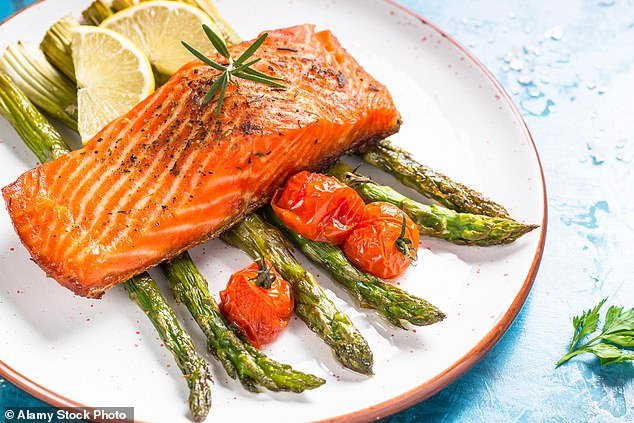
Salmon is Britain’s favourite fish, found at the heart of sushi platters, generously folded into bagels beneath a layer of cream cheese and served filleted and grilled alongside roasted vegetables.
But underneath salmon’s healthy reputation is the hidden risk that it can carry parasitic worms capable of causing life-threatening illness.
Like other marine fish such as cod and mackerel, salmon is a carrier of anisakis – a parasite which can be transferred to humans, triggering a disease called anisakiasis.
And with Britain’s appetite for salmon showing no sign of slowing – the industry is now worth around £1.5billion per year – it raises questions over whether enough people are aware of the risks.
Now, experts are urging Britons to understand how to protect themselves – and which popular dishes may pose the greatest threat.
Hany Elsheikha, professor of interdisciplinary parasitology at the University of Nottingham, says: ‘Symptoms of anisakiasis can range from having sudden abdominal pain to allergic reactions, inflammation of the bowel, vomiting or nausea.
‘It makes people’s lives really difficult. It’s a horrible disease and not something we’d like to experience.’
So, just how common are the worms – and how can we prevent them from harming us?

Salmon is Britain’s favourite fish and is often paired alongside roasted vegetables
Whether a salmon contains the worms depends on whether the salmon is wild – having been found in the ocean – or farmed, meaning it has been raised in controlled environments such as coastal nets or huge man-made tanks.
Anisakis worms are most commonly picked up in the ocean, when salmon eat infected prey such as krill, shrimp or smaller fish carrying the parasite. The worms can then migrate from the fish’s gut into its muscle tissue.
Farmed salmon, by contrast, are considered far lower risk because they are raised in controlled environments and fed processed pellet diets, preventing exposure to infected prey.
A Food Standards Agency Scotland study conducted around 20 years ago found no anisakis worms in any of the 720 farmed Scottish salmon examined. The vast majority of British salmon is from Scotland.
By comparison, the same report cited infection rates of more than 60 per cent in wild Norwegian salmon, while preliminary Scottish data found 100 per cent of wild salmon sampled carried anisakis worms, with some containing more than 100 parasites.
Once the worms are within the salmon, they then wait to be eaten by a marine mammal such as a whale or dolphin, allowing them to grow and reproduce before releasing eggs back into the ocean through faeces and continue the life cycle.
But the process is very different in humans.
As the worms cannot reproduce in a human’s stomach, they attach themselves to the walls of the stomach or intestine – triggering the anisakiasis infection in the body.
Within hours, those with the disease will begin experiencing symptoms including abdominal pain, nausea, vomiting, bloating, diarrhoea, blood or mucus in their stool, and a mild fever.
In some cases, the parasite can also trigger allergic reactions such as rashes, itching, or – in extreme cases – life-threatening anaphylaxis, which causes the immune system to flood the body with chemicals, triggering swelling, difficulty breathing, swallowing, wheezing, fainting or a change of colour to the skin.

However, sushi can also carry parasitic worms capable of triggering life-threatening illness

Salmon is also found in numerous types of sushi – which is growing in popularity in Britain
Some people report a tingling sensation in the mouth or throat after eating raw or undercooked fish, caused by the worm moving, and it may sometimes be coughed up, removed manually, or expelled through vomiting.
So, how can infection be prevented?
One expert in anisakiasis and a leading figure in parasitology told the Daily Mail that the risk of infection arises when contaminated fish is eaten raw, undercooked or insufficiently treated.
They also warned that other dishes linked to anisakis include sushi and sashimi, ceviche, lightly cured fish such as gravlax and rollmops, as well as marinated anchovies and escabeche – a marinated Spanish fish.
Britain’s Food Standards Agency (FSA) advises that while food business operators should visually inspect fish products for parasites before they are placed on the market, proper cooking or freezing remains the most effective way to kill any worms that may go undetected.
Cooking fish to a core temperature of 60C for a minimum of one minute is considered sufficient, while freezing is effective if the temperature is lowered throughout the product to -20C for at least 24 hours or -35C for at least 15 hours.
Under food hygiene rules, fish intended to be eaten raw – including sushi and sashimi – must undergo this freezing treatment, as must products where processing alone may not kill parasites.
Doctors have previously warned that the growing popularity of sushi in Western countries could lead to a rise in anisakiasis if fish is not handled or treated correctly.
Because sushi is eaten raw, strict freezing rules are in place to kill potentially harmful parasites before the fish is consumed.
But in rare cases, infections can still occur.
Writing in British Medical Journal Case Reports previously, medics described the case of a 32-year-old man who developed severe abdominal symptoms after eating sushi, with scans revealing a parasitic worm in his gut.
Professor Elsheikha says greater awareness of anisakiasis is needed, adding: ‘Before people eat something, they should look at it and see if they spot something abnormal.
‘The parasite is really big. You can see it easily. And they are coiled in certain ways, so even if anyone doesn’t know anything about this parasite , if they look thoroughly into the muscle they’d be able to notice it.’
