


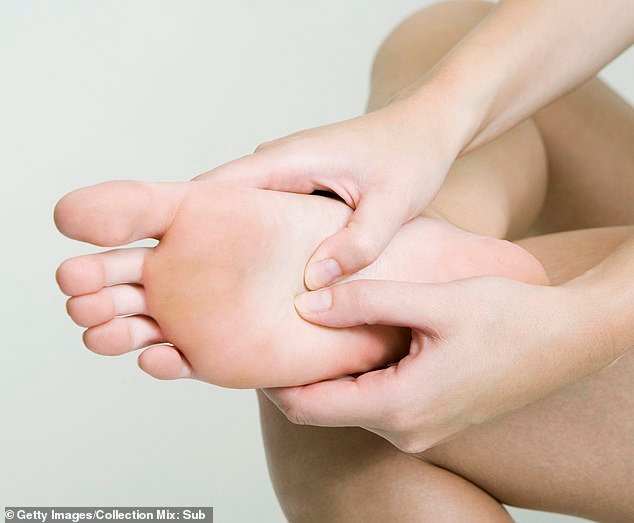
It often begins with something so minor you barely register it – a faint itch between the toes… a patch of skin that looks a little dry. Easy to ignore. Easier still to put down to nothing more than tired feet after a long day.
But experts warn that these seemingly harmless signs can be the first hint of a condition that is becoming increasingly difficult to treat.
Athlete’s foot is a common fungal infection affecting an estimated 16 million Britons at any one time. And while for many it clears within weeks with over-the-counter creams, doctors say a growing number of cases are proving far more stubborn.
When the infection takes hold, the skin can become red, cracked and inflamed, peeling away in strips as the itch intensifies. In some cases it spreads to the toenails, leaving them thickened, discoloured and brittle.
Athlete’s foot – or tinea pedis – can also open the door to more serious problems. Breaks in the skin allow bacteria to enter, increasing the risk of infections such as cellulitis – a potentially serious condition that causes painful swelling, redness and heat in the deeper layers of the skin, and can require urgent treatment.
And the fungus rarely stays put. Once established, it can spread beyond the feet, creeping into other warm, hidden folds of the body – the groin, the buttocks, the inner thighs – turning a minor irritation into something far more persistent and difficult to shake.
Experts now warn that it can become effectively untreatable, even with the strongest over-the-counter creams, thanks to the rise of drug-resistant trichophyton – the fungus that often causes the infection.
Previously, a course of the antifungal terbinafine – found in many over-the-counter treatments – was usually enough to clear athlete’s foot. But now around a third of those being treated by the NHS need repeated treatment, while for some the creams are completely ineffective.

Athlete’s foot – or tinea pedis – is a common fungal infection affecting an estimated 16 million Britons at any one time

Experts also warn that athlete’s foot can be passed on directly from person to person, while those who sweat more are often more prone to infection
If the infection becomes hard to treat, patients may need to stay on antifungal medication for prolonged periods to control symptoms – and even then it may fail to respond and could worsen.
‘There is certainly some level of resistance in the fungus that causes athlete’s foot,’ says Professor Darius Armstrong-James, an infectious disease expert at Imperial College London. ‘There is now a proportion of cases where the creams do not work and oral antifungals have to be used alongside lifestyle changes.’
Where athlete’s foot strikes
Athlete’s foot is caused by a group of fungi known as dermatophytes, which also cause ringworm – scaly, red rashes that can appear anywhere on the body.
It can develop on moist, waterlogged skin, usually at first between the fourth and fifth toes, or on dry, flaky skin around the heels or elsewhere on the foot. Large, painful cracks can develop, and the infection can spread across the toes and sometimes to the soles of the feet.
‘When people come into my clinic, they often know that something is wrong, but they are too embarrassed to talk about it,’ says Dr Sabika Karim, a GP and skin specialist at Skin Medical in Northwood, north-west London.
‘They often come in for something else and I spot it, and then they tell me they have spent months using antifungal creams and it either will not budge or keeps coming back. What they often do not realise is that treatment without changing habits means it will not truly go away.’
Dermatophytes are usually passed on via skin-to-skin contact. The fungal spores can live on the skin and under fingernails for some time without triggering a rash, and they thrive in places such as wet towels, shared bathroom floors and changing rooms.
‘Simple changes like wearing flip-flops in gym showers, not sharing towels and keeping feet dry can really reduce the risk,’ says Dr Karim.
Experts also warn that athlete’s foot can be passed on directly from person to person, while those who sweat more are often more prone to infection. Once your feet have been contaminated, the warm, dark and sweaty environment inside shoes or trainers provides the perfect breeding ground for the fungus.
‘For athlete’s foot to develop, it needs the right combination of exposure to fungal spores and opportunity,’ says Dr Karim. ‘That might mean sweatier skin, skin in poor condition or someone with a weakened immune system.’
Why both your shoes and socks matter
Fungus thrives in places that are warm, dark and damp – which is why footwear is crucial.
Inside a shoe, temperatures can reach around 35C. Add sweat and darkness, and you have created ideal conditions for fungus to grow and spread.
A 2019 study by Japanese researchers analysing data from 420 people found that shoe type was a key factor in the risk of developing tinea pedis.
They found men were more likely to wear shoes that raised the temperature of their feet and were therefore more likely to develop athlete’s foot.
Cloth shoes, as well as closed leather shoes, were found to have the highest humidity levels, putting wearers at greater risk.
‘It is really important to wear breathable footwear,’ says Dr Karim. ‘While that is not always possible, it is important to rotate the shoes you wear. People often do not spend enough time barefoot, letting their feet breathe, so when at home try to spend more time without shoes and socks on.’
Research also suggests that socks can play an important role. A study in 2000 by Japanese researchers discovered that wool varieties were best at preventing infection because they reduced the chances of harmful spores remaining in prolonged contact with the wearer’s skin.
Wool is also more breathable than synthetic fibres such as nylon, which are commonly found in socks and tights.
By contrast, one of the worst habits is wearing shoes or trainers without socks, which allows sweat to build up directly on the skin and creates the warm, damp conditions in which fungus thrives.
Experts say that, wherever possible, feet should be kept cool and dry, with socks acting as a barrier to absorb moisture and reduce prolonged contact with spores.

Dr Sabika Karim says it is important ‘to wear breathable footwear and ‘rotate the shoes you wear’ to prevent infection

Dr Sangeeta Punjabi warns of complications from athlete’s foot, as the ‘infection breaks down the skin between the toes, creating an entry point for bacteria’
‘What matters most is keeping the feet dry – so changing socks regularly, not just daily but also after exercise,’ says Dr Karim.
‘And where possible avoid synthetic fabrics. I often see women who wear tights made from these materials developing athlete’s foot.’
To prevent reinfection, experts recommend drying thoroughly between the toes, as this is where fungus often first takes hold, and using antifungal powders inside shoes.
Not just a problem for athletes
Despite the name, it is not just athletes who are at risk.
A 2025 study published in the Qatar Medical Journal found that people aged over 70 were 25 times more likely to be diagnosed with athlete’s foot than those under 30, while obese people were at 15 times higher risk.
Dr Karim says: ‘I often see older people who are otherwise very health-conscious but have neglected their feet.’
Research also shows that diabetics are seven times more likely to develop athlete’s foot – and they are at far greater risk of complications.
This is partly because diabetes can damage blood vessels and reduce circulation to the feet, slowing the body’s ability to heal. It can also affect the nerves, meaning small cuts, cracks or infections may go unnoticed and untreated.
‘For people with diabetes, athlete’s foot is not only more common but can also wreak havoc,’ says Dr Sangeeta Punjabi, consultant dermatologist at Syon Clinic in west London, part of Circle Health Group.
‘The infection breaks down the skin between the toes, creating an entry point for bacteria. That can lead to cellulitis – a deeper skin infection that can spread quickly if not treated. I have seen this land people in emergency departments, because a mild fungal infection was left to progress.
‘If you are diabetic and you have athlete’s foot, it is really important to see a medical professional.’
Why home remedies often fail to work
With many patients reluctant to seek medical help for what appears to be a minor condition, plenty turn to home remedies in the hope of a quick fix.
Online forums are awash with suggestions – from tea tree oil to apple cider vinegar – but there is little robust evidence to show they work.
‘Home remedies can be dangerous. They are not evidence-based and they often cause further irritation,’ says Dr Punjabi.
Instead, experts say proper use of antifungal creams remains the most effective treatment for most cases.
Athlete’s foot is unlikely to get better on its own, but there are over-the-counter treatments at chemists, and they usually take a few weeks to work.
It is best to treat it as soon as symptoms appear. Treatment depends on the type of athlete’s foot a person has. Over-the-counter remedies are usually a good starting point, while a GP or podiatrist can advise on the most appropriate next steps.
The treatment recommended by the NHS is terbinafine – the active ingredient found in Lamisil Once and other high-street products.
However, Dr Punjabi warns: ‘It is really common for patients not to use the creams properly. They forget to apply them, or as soon as they see progress they stop. This is one of the reasons the infection is not fully cleared.

Treatment depends on the type of athlete’s foot a person has – but over-the-counter remedies are usually a good starting point
‘I advise patients to continue using the creams for a week after it appears to have gone.’
In hard-to-treat cases she often has to prescribe oral medication instead.
But experts say the number of difficult cases is rising, and there are calls for the NHS to implement new guidance.
Professor Armstrong-James and others say that under proposed recommendations, GPs would carry out skin-scrape biopsies on patients suspected of having a drug-resistant fungal infection. A small sample of skin is taken from the infected area, which is sent to a laboratory for testing.
That would allow specialists to determine whether the infection is resistant to common treatments such as terbinafine, or whether it may respond to another antifungal instead. The GP could then prescribe the right medication from the outset.
Experts argue that by ensuring fungal infections are treated with the correct drugs the NHS could drastically reduce the number of drug-resistant fungal skin infections in Britain.
‘It’s time for the NHS to take fungal skin infections more seriously,’ says Professor Armstrong-James.
‘We need to be better at spotting these drug-resistant infections if we want to stop them spreading. GPs don’t routinely do skin scrapings, and it’s important these are done more often if a resistant infection is suspected. If we can get better at spotting drug-resistant fungal infections, we will be able to effectively treat more patients.’
