

Diagnosed with an aggressive brain tumour that carries an average life expectancy of 12 to 18 months, Hannah Langton’s reaction, as a young mother of two, was understandable.
‘I want to live and be here to watch my girls grow up, so I’ll do whatever it takes,’ says Hannah, who has two daughters: Eva, ten, and Aura, two, with husband Gary, 43, an account manager.
Initially the 35-year-old fitness instructor had put the near-daily headaches and tingling in her left arm that first dogged her late in 2023 down to ‘mum life’.
‘I’d just had a baby so was getting little sleep,’ she says. ‘And I’d always been a headachy person, so I didn’t think there was a cause for concern.’
Then one morning in September 2024 Gary heard a thump downstairs in their home in Maidstone, Kent, followed by Eva shouting: ‘Mummy has fallen’.
Bolting downstairs, he found Hannah on the floor having a seizure. She was unresponsive, but her eyes were open.
Gary called an ambulance, bundled his daughters to a neighbour, then ran back to hold Hannah’s head steady as she experienced another seizure.

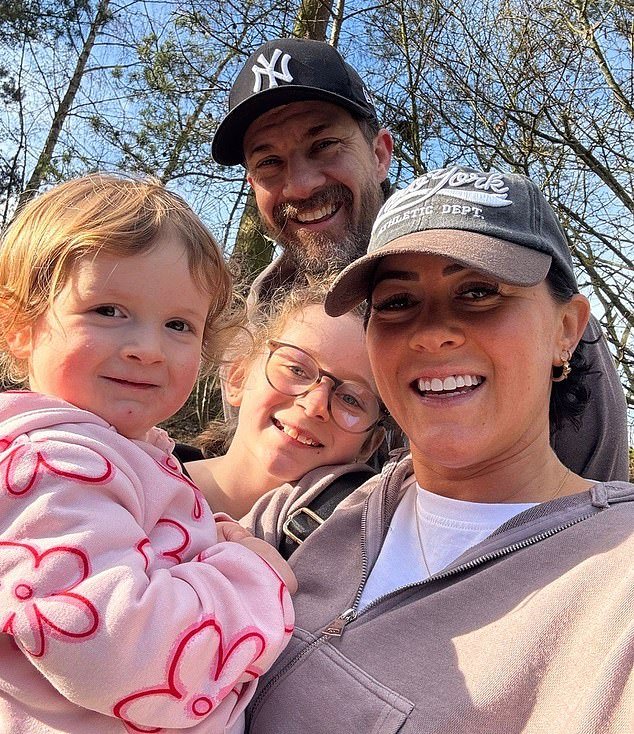
Hannah with two-year-old Aura, ten-year-old Eva, and husband Gary
Hannah remembers little of this, or of being rushed to hospital and the brain MRI and CT scans that rapidly followed.
But Gary recalls ‘the sickening fear in the pit of his stomach’ when, hours later, doctors told them there was ‘a mass’ in the right side of Hannah’s brain.
They were initially told it was slow-growing and ‘had probably been there for years’.
But two weeks later further scans revealed it was suddenly growing fast – brain surgery was needed within days.
A stunned Hannah replied, ‘but it’s my daughter’s birthday party next week, can’t we put it off?’. ‘I don’t think I understood the severity of my situation at first, or maybe I didn’t want to – it was so much of a shock I couldn’t take it all in,’ she now says.
Every day in the UK, 35 people are diagnosed with a brain tumour: it’s the biggest killer of the under-40s, according to the charity Brain Tumour Support, with 5,400 deaths each year. (The average age of diagnosis is in the 60s.)
‘A lot of patients are otherwise fit and healthy – a brain tumour hits them completely out of the blue,’ says Paul Brennan, a professor of neurosurgery at the University of Edinburgh.
The symptoms can be surprisingly subtle. ‘Not everyone with a brain tumour will have a headache,’ explains Professor Brennan.
‘There are early symptoms, such as changes in memory or personality – or mood changes and depression which can’t be explained by stress or anxiety.
‘Some may have dizziness; others may have weakness in their arms or face; and some will have seizures,’ he adds.
And symptoms can be confused for the menopause, adds Bridget Dowty, head of communication at Brain Tumour Support.
There are people walking around with a brain tumour ‘who until it causes symptoms have no idea they have one – and will never know because it never causes symptoms,’ says Professor Brennan.
‘However, others might have a small tumour, but if it is pressing on something important in the brain then that causes trouble.’
The risk a tumour poses depends on where it is growing – while some growths are benign, their location can prove lethal. Because the symptoms can be confused for less severe complaints, around two-thirds of cases are diagnosed in A&E at a point when a person’s condition is deteriorating – by which point they have had a seizure or become seriously unwell.

Hannah in the hospital. It was Gary who found her when she collapsed

Hannah underwent surgery to have the tumour removed, with the wound held together with staples
To encourage earlier diagnosis, Brain Tumour Support is campaigning for greater awareness of the symptoms among both public and GPs.
Meanwhile, Professor Brennan is part of a team that has developed a blood test that identifies proteins commonly found in the blood of people with a brain tumour – which in a recent trial ‘correctly identified 19 out of 20 cases’, he says.
It’s hoped the Dxcover brain cancer test, currently available privately in the UK at a cost of £395, will be offered on the NHS to those with vague symptoms that might suggest a brain tumour to speed up diagnosis.
‘Treatments haven’t significantly changed in 20 years, which is why early detection is important – it gives people the best chance of responding to the treatments we do have,’ says Professor Brennan.
And while ‘in other parts of the body we can safely remove large amounts of tissue, we can’t do that in the brain’, he adds.
Warned she risked having a stroke during the operation – on October 30, 2024 – Hannah found herself awake in the small hours before, worrying: ‘What if I came round unable to walk or talk?’
To enable surgeons to remove as much as possible of the 5.5cm tumour without damaging key parts of the brain, Hannah was told she needed to be brought round from her general anaesthetic part way through her operation. This way they could speak to her and watch for changes in her speech that could suggest the surgeon was getting close to areas relating to this.
As Hannah was brought round in theatre, ‘I was thinking “this is mad, my brain is open”,’ she recalls.
After four hours awake, she was heavily sedated as doctors used staples to close the incisions.
When she came round, there was ‘crushing disappointment’: surgeons had only managed to remove 60-70 per cent of the tumour.
Days later there was more bad news: a biopsy revealed she had a stage 4 astrocytoma, an aggressive tumour that starts in the support cells of the central nervous system.
Hannah, who’d done her research, knew this had an average survival rate of 12 to 18 months. She says: ‘I was heartbroken, I had been on a high thinking “I can do this” and suddenly I was looking at a very different prospect.’
Rather than quietly accept her fate, however, Hannah was determined to do whatever she could to improve her survival chances.
Still in severe pain and with metal staples ‘running from the crown of my head to the top of my ear’ – and swelling so severe she couldn’t open her eyes for days – within a fortnight of her operation, Hannah started a six-week course of daily chemotherapy tablets, alongside 30 sessions of radiotherapy.
It was tough for the whole family. The girls didn’t see their mum for ten days after her surgery while her swelling subsided.
‘The first few nights I was back with Eva I slept in her bed, and we fell asleep holding hands,’ says Hannah.
The girls generally accompanied their parents to hospital appointments – including on Christmas Eve – waiting outside in the car with Gary.
‘We didn’t want the girls to go into the oncology unit, but we didn’t have anyone to look after them every day,’ says Hannah.
‘Gary put me in a bubble,’ she adds. ‘I just turned my phone off. My whole focus switched to my family and survival.’
The first scan after the treatment showed the remainder of the tumour was shrinking.
‘I thought “oh my god I’m going to do this” – and I haven’t doubted myself from that moment,’ says Hannah, who then took chemotherapy tablets for a year.
‘I didn’t breeze through it – I was really fatigued, I had no appetite, felt very queasy and lost 80 per cent of my hair – but I will do whatever it takes,’ she says.

The mother of two still carries the scars, but a scan earlier this year showed no sign of cancer
Hannah’s treatment ended on New Years’ Eve (2025) – she was elated when a scan in January showed no sign of cancer.
She and Gary decided to spend their life’s savings, £10,000, installing a hyperbaric oxygen chamber (the kind used by divers after rising too rapidly from deep waters) in their home, after studying research suggesting this might increase her chances.
‘It looks like a little tent we zip up – it’s in our bedroom and once the kids hear it going, they know that Mummy is in her tent and they aren’t to bother her,’ says Hannah.
She spends an hour a day in the chamber for 30 days, followed by a week off – ‘as I’ve read that is most effective’.
The theory is that an oxygen-rich environment helps make cancer cells more suspectable to chemotherapy.
It is also thought to help prevent the proliferation of cancer cells – a review in 2012 in the journal Target Oncology, for example, said oxygen therapy ‘can be inhibitory and reduce cancer growth in some cancer types’.
Hannah also takes baby (75mg) aspirin, turmeric and berberine – all thought to have anti-inflammatory effects that may help prevent cancer recurring – having first consulted her medical team.
She also uses a head device that emits infrared light for 15-30 minutes a day – there’s some evidence this may help reduce inflammation.
Professor Brennan emphasises that oxygen chambers and supplements are no substitute for the mainstream treatment, but says he’d like to see ‘trials to see if there’s a basis to recommend these additional approaches’.
Hannah’s last scan two weeks ago showed no sign of the cancer. She knows that 90 per cent of grade 4 astrocytomas recur – mostly within 24 months of diagnosis. She’s currently at month 20.
Hannah has found the counselling provided by Brain Tumour Support helpful, for her family too. Eva was initially very anxious – ‘we didn’t use the word cancer with her until two months ago’, says Hannah.
‘But now she tells me how brave I am and I think she is finding it empowering. She recently won an award for a speech at school on bravery.’
Next week Gary will run two back-to-back marathons – he will run the route of the London marathon in reverse at 3am – and the marathon itself at just after 9am.
Half the money raised will go to Brain Tumour Support, and half towards Hannah’s treatment.
Hannah is adamant she will beat the odds.
She says: ‘I don’t care how much money I have, I don’t care if I’m bald forever, I don’t care if I’m never allowed to drive again [her licence was suspended after her seizure] – I just want to watch my children grow up.
‘As long as you are alive – you have hope.’
To donate visit: gofundme.com/f/running-london-marathon-twice-back-to-back
