


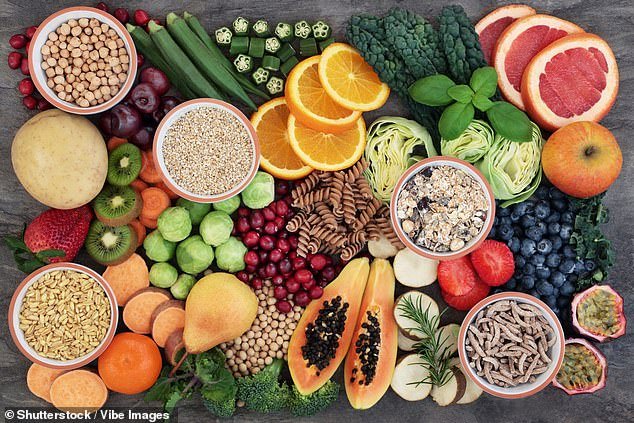
They’re pillars of a healthy, balanced diet – associated with a decreased risk of most serious diseases, and full of key nutrients.
But a surprising new study from researchers in Southern California has linked eating fresh fruit, vegetables and whole grains to an increased risk of lung cancer.
Nearly 48,000 people in Britain are diagnosed with lung cancer each year – making it the third most common cancer in the UK.
Most cases of the disease are linked to smoking.
Yet while overall cases of the disease have gone down in recent decades, lung cancer in non-smokers under the age of 50 has only grown in prevalence.
Today, around 20 per cent of lung cancer diagnoses are in people who’ve never smoked – and studies suggest that figure is set to rise.
Previous research has linked the phenomenon to increased air pollution and exposure to hormone-disrupting chemicals.
Now, researchers say diet may also play a role – likely due to toxic pesticides used to grow crops.

Researchers believe that eating fruit, vegetables, and whole grains could increase the risk of developing lung cancer in non-smokers under the age of 50 – because of pesticides
‘Our research shows that younger non-smokers who eat a higher quantity of healthy foods than the general population are more likely to develop lung cancer,’ said the study’s lead author, Dr Jorge Nieva, a lung cancer specialist at the University of Southern California.
‘These counter-intuitive findings raise important questions about an unknown environmental risk factor for lung cancer related to otherwise beneficial food that needs to be addressed.’
Concerns around chemical pesticides – substances sprayed on foods to repel pests and halt the growth of weeds and fungi – are not new.
Pesticides have been linked to cell DNA damage, hormone disruptions and inflammation – all of which raise the risk of cancerous tumors.
The World Health Organisation (WHO) have called the chemicals ‘intrinsically toxic’ and deemed them ‘among the leading causes of death by self-poisoning’.
Dr Nieva, who presented the team’s research at the annual meeting of the American Association for Cancer Research, said mass-produced fruits, vegetables and whole grains are likely to carry higher pesticide residues than dairy products, meat and many processed foods.
He also noted that agricultural workers exposed to pesticides have typically shown higher rates of lung cancer.
The team surveyed 187 patients who had been diagnosed with lung cancer by the age of 50, and logged their demographics, diet and smoking history.
Surprisingly, most of them had never smoked – and their form of lung cancer appeared different from the type usually caused by smoking.
The researchers graded each patient’s diet on a scale of 1 to 100 using the Healthy Eating Index – a tool developed by the United States Department of Agriculture.
The non-smokers had an average score of 65, above the national average of 57.
They were also found to eat more daily servings of fruit, vegetables and whole grains than the general US population.
Participants averaged 4.3 daily servings of dark green vegetables and legumes, along with 3.9 servings of whole grains every day.
By comparison, the average US adult consumes 3.6 servings of dark green vegetables and legumes and 2.6 servings of whole grains each day.
The team did not test individual foods for pesticide levels, instead using existing data on pesticide levels in foods like fruit, vegetables and grains to estimate exposure.
Dr Nieva said the potential link between pesticides and lung cancer in young people requires further research to help determine whether certain pesticides carry a greater risk than others.
‘This work represents a critical step toward identifying modifiable environmental factors that may contribute to lung cancer in young adults,’ he added.
‘Our hope is that these insights can guide both public health recommendations and future investigation into lung cancer prevention.’
Other experts were more skeptical of the study’s findings, however.
Dr Baptiste Leurent, associate professor in medical statistics at University College London questioned whether other confounding factors could explain why early-onset lung cancer patients were more likely to have healthier diets.
‘As this is a younger and non‑smoking population, it could simply reflect the fact that younger people, or non‑smokers, tend to have healthier diets than the general population,’ he said.
‘Overall, this abstract provides little evidence of an association between diet and lung cancer, let alone any causal link, and offers no meaningful support for claims regarding pesticides.’
Added Professor Peter Shields of Ohio State University: ‘This research should be considered exploratory, as it is in early stage, and is a small study.
‘It would likely be harmful for people to avoid fruits and vegetables because of concerns for lung cancer.
‘Smoking is by far the leading driver of lung cancer. Patients with lung cancer who have never smoked is rising, but still rare, and the well-known benefits for eating fruits and vegetables (and other positive lifestyle factors) far outweigh any speculation of data interpretation from this study.’
Meat-heavy diets have also been linked to lung cancer. According to a 2014 Chinese study, regularly consuming red meat raises the risk of the disease by as much as 35 per cent.
Experts also point out that it’s unclear which pesticides may be linked to lung cancer.
Several pesticides still used in the US, where the study took place, are banned in the UK.
Insecticide Chlorpyrifos was banned in Britain in 2016 after evidence revealed it can harm the cognitive development of foetuses and young children. It is still allowed in US food production, however.
Toxic weedkiller Paraquat was also banned in the UK due to risks of Parkinson’s disease, but is still used extensively in the US.
British crops are still sprayed with pesticides banned by the EU, however.
These include Dimethomorph, which is typically sprayed on strawberries and onions, Benthiavalicarb, used on potatoes, and Ipconazole, authorised in the UK for barley and wheat seeds.
