


It’s a rare and disturbing phenomenon – people pretending they, or their child – are ill, in order to garner sympathy and attention.
Known as Munchausen’s by proxy syndrome, or factitious disorder imposed on another (FDIA), the psychological disorder is complex and poorly understood.
In most cases – nearly 91 per cent – it’s a mother who pretends her child is ill.
The most famous example is Gypsy Rose Blanchard, 34, who killed her mother after spending most of her childhood falsely believing she had a range of debilitating health issues.
But a surprising new study suggests the phenomenon could also be occurring with a hitherto unnoticed victim group: pets.
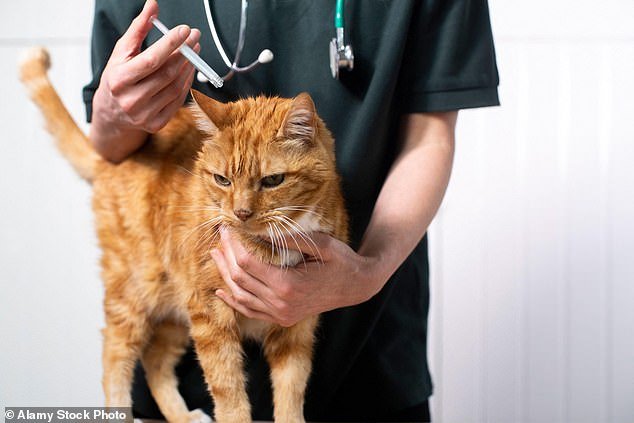
Researchers in the Netherlands found that more than half of veterinarians say they have ‘likely’ seen the phenomenon in their clinics – with dogs and cats the most common proxies.
Signs of abuse included uncommon fractures and inexplicable injuries, signs of starvation in the animals, signs of lameness and signs of poisoning.
Despite the number of vets who said they had witnessed the phenomenon, just four per cent said they had ever reported the pet owner for animal abuse.
‘Animal abuse by falsification is recognised by a part of the Dutch veterinary profession and warning signs of the phenomenon are known to some extent,’ wrote Dr Ineke van Herwijnen, co-author of the study and junior professor at the University of Utrecht.

Researchers in the Netherlands found that more than half of veterinarians say they have ‘likely’ seen the phenomenon in their clinics – with dogs and cats the most common proxies
‘Yet, presently little guidance exists for early recognition of these particular animal abuse cases.’
Named after a German aristocrat, Baron Munchausen, who became famous for telling wild, unbelievable tales about his exploits, Munchausen’s syndrome is complex and poorly understood.
Many people refuse psychiatric treatment or psychological profiling, and it’s unclear why people with the syndrome behave the way they do.
Some people with Munchausen’s syndrome may spend years travelling from hospital to hospital faking a wide range of illnesses in themselves or their child. When it’s discovered they’re lying, they may suddenly leave hospital and move to another area.
People with Munchausen’s syndrome can be very manipulative and, in the most serious cases, may undergo painful and sometimes life-threatening surgery, even though they know it’s unnecessary.
In pets, Munchausen’s by proxy looks relatively similar to how it appears in humans, say researchers.
Animals can be poisoned, injured or starved to create the need for veterinary treatment – while others are brought in for conditions that mysteriously disappear once the animal is examined.
Nearly 90 veterinarians were surveyed in the study, which was published in the journal PLOS One last week.
Of those surveyed, 51.2 per cent said they were likely to see cases of Munchausen’s by proxy in animals – also known as animal abuse by falsification.
Cases were most common in cats and dogs, but vets also noted seeing signs in rabbits, rodents and a horse.
Vets surveyed said the most common tell-tale sign of animal abuse by falsification were animals being brought in for ‘vague or inexplicable complaints’ that were ‘difficult to check or confirm medically’.
Others reported ‘incompatibilities between medical history and clinical findings’ as well as owners ‘relatively often visiting the clinic with this or multiple animals’.
The low rates of reporting this form of animal abuse were likely due to the lack of clear standards in identifying the phenomenon, the research team concluded.
Vets also cited their own lack of knowledge of available resources and concerns about breaking client confidentiality.
‘Due to the existence of variants of the phenomenon, just like in child abuse cases, diagnosing AAF in animal abuse cases will be challenging,’ wrote the research team.
‘It is therefore logical that our participants indicate the need for more knowledge on AAF, and on support when dealing with suspected AAF cases.’
Better identification of cases of animal abuse by falsification could also help catch cases of child abuse by falsification, they concluded.
Several historic cases of Munchausen’s by proxy in children have also involved pets – with one 2001 case of a child being poisoned by a parent also involving the poisoning of a pet dog.
