


Concerns are mounting that we may have sleepwalked into a household chemical exposure crisis – and now, the Government has finally moved to act.
Ministers have confirmed they will overhaul Britain’s decades-old furniture fire safety rules, scrapping a controversial test that effectively forced sofas to resist a naked flame – driving widespread use of chemical flame retardants.
It will be replaced with a less extreme ‘cigarette-style’ test, checking whether furniture ignites from a smouldering source – a change expected to cut the need for these chemicals.
It comes as scientists warn that alongside so-called ‘forever chemicals’ (PFAS), used in everything from non-stick pans to food packaging, flame retardants in furniture represent a second, largely overlooked source of everyday exposure inside the home.
For years, attention has focused on PFAS – a group of man-made compounds prized for their durability.
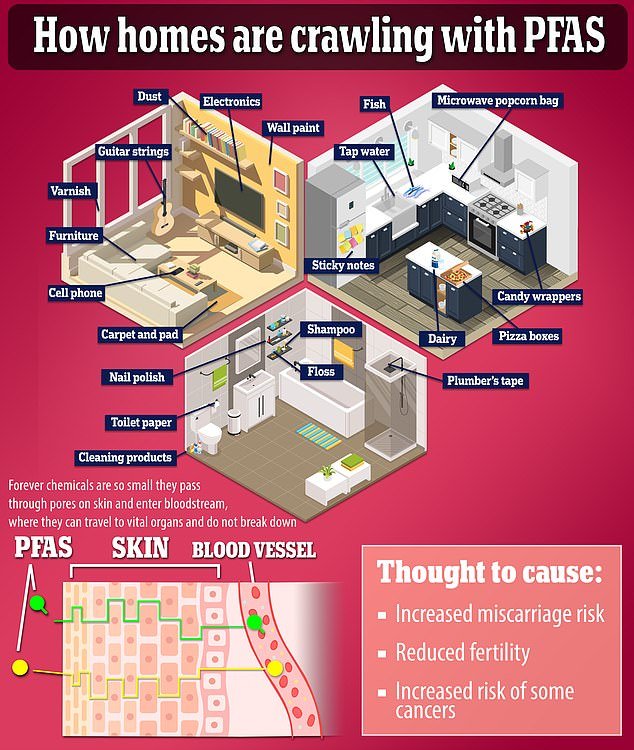
Resistant to water, grease and stains, they have been used in a vast range of products, from cookware and clothing to carpets, cosmetics and takeaway packaging.
Only in recent decades have their health effects become clear, with research linking PFAS to cancers, immune dysfunction, fertility problems and birth defects. Because they do not break down, they accumulate in the body and environment – earning the nickname ‘forever chemicals’.
But experts now say this is only part of the picture. Below, we look at where these chemicals are most likely to be found in the home – and what the risks may be.

Sofas and furniture – a British chemical legacy
For decades, UK sofas have been chemically treated to meet strict fire safety rules.
To pass the ‘open flame’ test introduced in 1988, manufacturers have relied on flame retardants such as TCPP – an organophosphate compound that can make up a significant proportion of sofa foam and has been classified as ‘possibly carcinogenic’.
These chemicals do not stay locked inside furniture. Over time, they escape into household dust, where they are inhaled or ingested – particularly by babies and young children who spend more time on the floor.
Studies have linked exposure to hormone disruption, reduced fertility, developmental problems and possible increased cancer risk.
The Government now plans to scrap the test in favour of a smoulder-based standard – meaning furniture will no longer have to withstand a direct open flame, but instead resist ignition from a smouldering source such as a lit cigarette.
This change is expected to significantly reduce the need for chemical flame retardants.
In most cases, you can’t tell just by looking – there is no requirement for manufacturers to clearly list which chemicals have been used in the foam.
However, there are some clues.
Sofas sold in the UK since 1988 must carry a permanent fire safety label, usually stitched under a cushion or on the frame, confirming they comply with fire regulations. If your furniture has this label, it is likely to have been treated to meet the old standard – often using flame retardants.
Older sofas – particularly those made before recent voluntary shifts away from certain chemicals – are more likely to contain higher levels.
By contrast, furniture bought very recently may contain fewer or no added flame retardants, as manufacturers begin to adapt ahead of regulatory changes.
However toxicologist Dr Robin Mesnage, scientific director of the Buchinger Wilhelmi clinic, says: ‘As a simple rule, if you notice the typical “new” smell from furniture or textiles it is a red flag. It means some toxic chemicals are being released, even if you don’t know which ones.’
The only way to know for certain is through laboratory testing of the foam – something not available to most consumers.
Drinking water – the most widespread exposure route

Using a water filtration drug can help eliminate toxic forever chemicals
PFAS contamination of drinking water is one of the most widespread exposure routes.
In the US, studies suggest around 45 per cent of water sources contain at least one PFAS compound. Contamination typically occurs through industrial discharge, landfill runoff and the breakdown of consumer products.
Because PFAS do not degrade, they accumulate in water systems – and ultimately in the human body.
Long-term exposure has been linked to cancers, immune suppression, hormone disruption and fertility issues.
Dr Mesnage says people living near areas where firefighting foams are used – such as airports, military bases and industrial sites – should be particularly cautious about their drinking water, because these foams often contain PFAS that can seep into soil and contaminate local water supplies.
Professor Stuart Harrad, an environmental chemist at the University of Birmingham, added: ‘While current PFAS levels in most water samples are not a major health concern, ongoing monitoring and regulation are crucial to protect public health.’
He added: ‘Increased awareness about the presence of PFAS in both tap and bottled water can lead to more informed choices by consumers, encouraging the use of water purification methods.’
Boiling water and using filtrations jugs, which cost around £15 at most supermarkets, have been shown to reduce PFAS concentration by up to 90 per cent.
Kitchen – non-stick pans and takeaway packaging

Non-stick coating, found everywhere from frying pans to food wrappers, are a major source of PFAS
Non-stick coating, found everywhere from frying pans to food wrappers, are a major source of PFAS
These chemicals are used to create surfaces that repel oil and water – but can degrade over time, especially when pans are scratched or overheated, releasing particles that contaminate food.
‘Because of these properties, PFAS are extremely persistent in the environment,’ says Dr Julian Campo, an expert in environmental toxins at the University of Valencia – meaning they do not easily break down and can remain in the environment, and in the human body, for years.
PFAS are also commonly found in takeaway containers, microwave popcorn bags and pizza boxes, where they can leach into food – particularly when heated.
‘The most striking example resonation with consumers is junk food packaging,’ Dr Mesnage said.
‘Many wrappers contain PFAS to help them repel grease. But these chemicals can leach into food, and then the bloodstream, with higher levels of these forever chemicals linked to problems losing and maintaining weight.’
To reduce exposure, Dr Mesnage advises avoiding reheating food in its original fast-food packaging.
Repeated low-level ingestion is thought to contribute to the build-up of these chemicals in the body.
‘These compounds are highly toxic and pose a clear potential danger to human health, as they act as endocrine disruptors, in addition to causing liver damage, thyroid disease, obesity and being associated with fertility problems and cancer,’ Dr Campo added.
‘Once in the environment, PFAS have the potential to bioaccumulate, meaning that their concentration progressively increases as one moves up the food chain.’
Bathroom – cosmetics and personal care

Hundreds of cosmetic products have previously been revealed to contain PFAS, ‘forever chemicals’ and other cancer-causing ingredients
PFAS have been detected in a wide range of cosmetics and personal care products, including foundations, mascaras, lipsticks and skincare.
They are added to improve texture, durability and water resistance – helping products stay on the skin for longer.
However, studies suggest they can be absorbed through the skin or accidentally ingested, contributing to overall exposure.
Some may be listed on labels under names such as PTFE, ethanolamines or perfluoro-compounds, though not all are declared.
Ethanolamines are chemicals made up of amino acids and alcohols, and are typically found in soaps, shampoos and shaving creams.
Whilst it is not a banned substance and can also be used in cosmetics, there are fears the colourless sticky liquids could be carcinogenic.
‘The concern here is that under certain conditions, ethanolamines can undergo a reaction to make nitrosamines which are potentially carcinogenic,’ Dr Mary Sommerlad, a consultant dermatologist, said.
But experts say this can only happen when ethanolamines, such as diethanolamine (DEA), are used in the same product as preservatives.
Clothing – waterproof and stain-resistant fabrics
PFAS are widely used in textiles to make them waterproof or stain-resistant.
They are commonly found in outdoor jackets, school uniforms, carpets and some sportswear labeled waterproof.
These chemicals can rub off onto the skin or be released during washing, entering water systems and re-circulating through the environment.
‘Choose PFAS-free textiles and look for labels such as ‘fluorine-free’ and avoid vague claims like ‘stain-resistant’ without clear detail,’ Dr Mesnage advises.
Electronics and cars – hidden sources of flame retardants

The new car smell is caused by volatile organic compounds given off by leather, plastic and vinyl
Flame retardants have also been widely used in electronic devices such as TVs, laptops and phones, as well as in car seats and interior materials, to reduce fire risk.
One of the tell-tale signs is that classic new car smell, Dr Mesnage says, with everyday products like treated textiles being one of the main sources of PFAS exposure.
Over time, these chemicals can migrate out of plastics and foam, contributing to levels found in indoor dust.
Older products are more likely to contain higher levels of certain flame retardants that have since been phased down.
Dust and everyday items – the invisible build-up
Because both PFAS and flame retardants can escape from products over time, they accumulate in household dust.
This creates a constant, low-level exposure route through inhalation or ingestion – particularly for children.
They have also been detected in a wide range of everyday items, including paints, cleaning products, carpets and even some food products.
The problem is that whilst cleaning your home has a number of health benefits – from removing pollen and dust mites to preventing mould from taking hold – a lot of multi-purpose cleaners, especially those with ‘stay-clean’ claims, contain PFAS.
And so do dishwasher and laundry detergents, to help break down grease and stains.
‘Studies have shown a potential link between chemical disinfectants and the risk of developing conditions like COPD,’ Dr Bhavini Shah, an NHS GP explains.
COPD is an umbrella term for a number of lung conditions, including emphysema, that cause breathing difficulties.
‘Despite many products lacking clear labels, products containing volatile compounds, like disinfectants and cleaners can harm your health, increasing the risk of triggering lung conditions. And if you already have breathing difficulties, its crucial to avoid there chemicals.’
