

IVF has helped millions of families have children who otherwise might never have existed – a medical breakthrough that has transformed modern parenthood.
The treatment, known as in vitro fertilisation, involves combining eggs and sperm in a laboratory before transferring the resulting embryo into the womb.
But behind the success stories lies a far more unsettling reality: when the system fails, it can do so in the most catastrophic way imaginable.
In rare but deeply disturbing cases, embryos are mixed up, identities are lost and families are left raising children who are not biologically theirs – sometimes for months, sometimes for decades.
In a remarkable case reported by the Daily Mail last week, Australian twins Sasha Szafranski and her sister only uncovered the truth about their origins as they approached their 30th birthdays.
What began as a casual Ancestry DNA test instead revealed a bombshell: they were not biologically related to the parents who raised them.
Instead of confirming their father’s Polish roots, the results pointed to Ireland and England – and to a stranger living in the same town who appeared to be their biological aunt.
Further investigation revealed that in 1995, at Royal North Shore Hospital in Sydney, that during the IVF treatment that helped concieve them, the wrong embryo had been implanted into their mother, Penny.

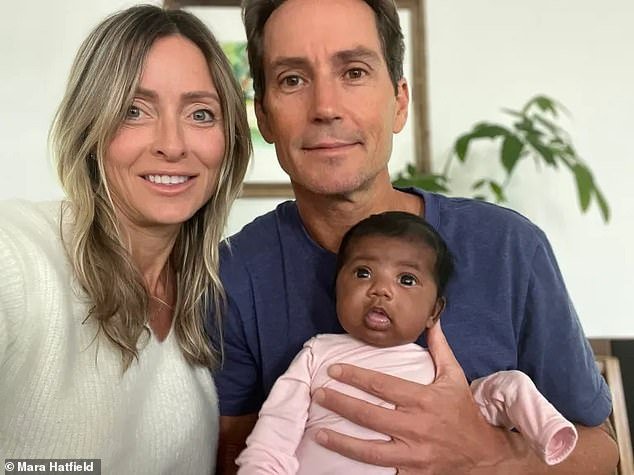
After welcoming a baby girl in 2025, Tiffany Score and Steven Mills became concerned when the child did not genetically resemble either parent
DNA tests later confirmed the devastating truth: the twins were the biological children of another couple undergoing treatment at the same clinic.
‘I gave birth to them… they were my girls. There was no thought that they weren’t,’ Penny said of her daughters.
‘The mistake that happened 30 years ago… we just have to go on with it somehow and it’s awful. It shouldn’t have happened.’
It is only the second known case of its kind in Australia – and it follows another recent scandal that exposed just how easily things can go wrong.
In Brisbane, a woman gave birth to a stranger’s baby after being implanted with the wrong embryo at a Monash IVF clinic in what the company later admitted was ‘human error’.
The mistake was only uncovered months after the birth, when the biological parents asked to transfer their remaining embryos and an unexpected extra embryo was discovered in storage.
Both families were left devastated, with the clinic issuing a public apology and insisting the incident was an isolated failure despite strict safety protocols.
But embryo swaps are not the only way IVF can go catastrophically wrong.
In another Australian case, a white couple gave birth to a biracial baby after a sperm mix-up at a Brisbane fertility clinic.
The embryos had been created using donor sperm imported from the US, with the couple selecting a donor who matched the father’s appearance – fair hair and blue eyes.
Instead, the sperm sample had been incorrectly labelled at the source, with semen from two different donors mixed up.
The error only became clear after the baby was born.
‘I love my beautiful baby more than life itself… but has anyone ever found out their IVF baby wasn’t theirs?’ the mother, who has not been named, wrote at the time as she awaited DNA test results.
An investigation later found the US sperm bank had not been using a key identity check known as double-witnessing when the sample was collected – a safeguard designed to prevent exactly this type of mistake.
The couple eventually reached a settlement, but the case only came to light more than a decade later.
Similar cases have emerged around the world.
In Florida, a new mother is suing a fertility clinic after giving birth to a baby she believes is not biologically hers.
The couple, both described in court documents as white, became suspicious when their newborn appeared to be of a different racial background.
‘Tragically, while both Jane Doe and John Doe are racially Caucasian, Baby Doe displayed the physical appearance of a racially non-Caucasian child,’ the lawsuit states.
Despite the shock, the parents say they have formed an ‘intensely strong emotional bond’ with the child – even as they face the possibility that their own biological baby could be being raised by strangers.
A separate Florida case echoes the same nightmare.
Tiffany Score and Steven Mills say they were overjoyed to welcome a baby girl after IVF treatment – only to discover through genetic testing that she is not biologically theirs.
Now, they are demanding answers from the clinic, fearing that one of their own embryos may have been implanted into another family.
‘They have fallen in love with this child,’ their lawyer said, but remain haunted by the possibility she could be taken from them.
Some families have faced an even more unthinkable decision.
In California in 2019, two couples discovered they had been raising each other’s biological daughters after an IVF mix-up.
Alexander and Daphna Cardinale had welcomed a baby girl, May, and raised her for months before DNA tests revealed neither of them was biologically related to her.
At the same time, another couple – Annie and her husband – were raising the Cardinales’ biological daughter, Zoe.
After meeting, the couples made the extraordinary decision to swap the babies back.
The transition was gradual, moving from visits to overnight stays before the girls returned to their genetic parents – but the emotional fallout was profound.
‘I carried this child. I birthed her. She felt so familiar to me that it didn’t even occur to me that she couldn’t be ours,’ Daphna said.
Even after the swap, both families remained closely intertwined – spending holidays together and raising the girls as part of a blended extended family.
‘There’s no person to give you advice,’ Alexander said. ‘So we ended up just sort of huddling together… and it’s a blessing that we all are on the same page.’
In New York, another couple gave birth to twin boys who were not biologically theirs, leading to a legal battle before the children were returned to their genetic parents.
And in the UK, one of the most infamous cases occurred at Leeds General Infirmary in the early 2000s, when a sperm mix-up led to a white couple having mixed-race twins.
An official investigation blamed human error and poor labelling, prompting sweeping changes to safety procedures that still shape fertility regulation today.
Even now, the legal and ethical consequences remain murky.
In Australia, experts say the law tends to prioritise the woman who gives birth – meaning biological parents may have little claim, even in cases of proven error.
That reality has already played out in Brisbane, where the birth mother is likely to retain parental rights, despite the child not being genetically hers.
Cases like these remain exceptionally rare – but not impossible.
A 2018 US study estimated major IVF errors occur roughly once in every 2,000 cycles, with less serious mistakes happening far more frequently.
In the UK, there have been no cases of embryos being implanted into the wrong patient in recent years, according to fertility regulator figures – but hundreds of other incidents and near misses are still recorded.
Modern clinics rely on barcode tracking, strict lab protocols and double-witnessing systems designed to prevent exactly these kinds of mistakes.
But IVF, for all its technological sophistication, still depends on human handling at every stage.
And as these cases show, when something goes wrong, the consequences are not just clinical – they are lifelong.
