


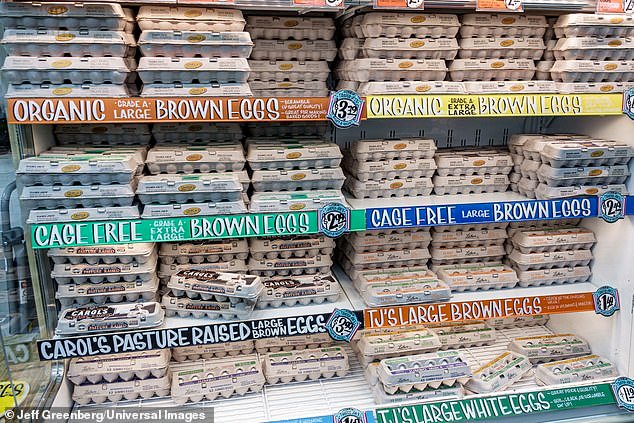
Would you be willing to spend more on everyday staples like eggs, bananas and chocolate if you believed they were healthier and free from harmful chemicals?
Millions of Americans do just that, paying a premium for organic food, convinced it’s not just better for the environment and animal welfare but, crucially, better for their bodies.
Shoppers choosing organic routinely spend far more on groceries, believing they contain more nutrients and fewer potentially harmful pesticides – some of which have been linked in research to serious, life-limiting diseases.
But experts speaking to the Daily Mail say the reality is far more complicated.
Indeed, experts warn the organic label often falls short of what shoppers expect – offering no clear proof of superior nutrition, no outright ban on pesticide use, and only limited assurances about how animals are reared.
In the US, food must meet strict federal standards to carry the US Department of Agriculture (USDA) organic label.
But at its core, ‘organic’ refers to how food is produced – not what it contains.
Farmers must avoid most synthetic pesticides and fertilizers, as well as genetically modified organisms (GMOs).

The USDA Organic label has long provided minimal meaningful protection for farmed animals. Cage-free, for example, means hens can move about within enclosed barns, but it does not guarantee access to grassy pastures or outdoor roaming
Routine antibiotic use in livestock is prohibited and producers instead must rely on natural or approved substances and specific farming practices.
There are also different tiers of certification, from ‘100% organic’ to products made with at least 70 percent organic ingredients, though only the highest categories can carry the USDA seal.
To cut through the hype, the Mail asked experts to break down what ‘organic’ really guarantees – and what it doesn’t. Their answers may come as a shock to anyone who routinely pays extra for it.
One of the biggest misconceptions is that organic food is completely pesticide-free. It isn’t.
Organic farming still uses pesticides – they are just typically derived from natural sources or specifically approved under organic rules.
These include substances such as copper-based compounds and microbial agents like Bacillus subtilis.
While typically considered low risk for consumers, studies suggest some organic pesticides – particularly copper-based ones – can build up in soil and affect microbes and other organisms over time.
And while the risk to consumers from residues on food is low, organic farmer Patrick Martin says these substances can still pose a risk to those handling them in large quantities.
Martin, who produces organic olive oil, said: ‘With substances like copper, the main concern would be acute toxicity – but in practice, that’s not really an issue.
‘For that to become a problem, you’d have to consume it in significant amounts.
‘In terms of skin or respiratory irritation, or allergic reactions from handling it, those can happen – but I’d expect that mainly in situations where safety standards are poor. It’s not something I’d consider especially common.’
While the risks from approved substances may be limited, experts say the wider organic system is not without its flaws. Regulators, including the Environmental Protection Agency, assess pesticides used and set safety thresholds – but enforcement is not foolproof.
In 2019, the US Department of Justice uncovered a $142 million fraud in which Missouri grain dealer Randy Constant sold conventionally grown grain as organic – one of the largest cases of its kind.
Federal watchdogs have also raised concerns about weaknesses in monitoring imported organic products, prompting tighter oversight in recent years.
And it’s not just about chemicals. Many shoppers assume organic automatically means animals are raised in humane, free-roaming conditions – but that, too, is not always the case.
Organic rules require ‘access to the outdoors,’ yet the definition is broad and has historically been loosely enforced, Martin said.
‘Cage-free’ eggs, for example, mean hens can move around indoors, not that they roam on open pasture, and outdoor access can, in some cases, amount to little more than a small covered area.
Dr Michelle Schack, a dairy cow veterinarian and founder of DairyKind, said the organic label does not guarantee high standards of animal welfare.
She explained that organic certification focuses on how farms are run – rather than how animals actually fare.
And, she says, farms can meet organic rules on paper while still falling short on the measures that matter most to vets.
‘When vets assess animal welfare, they look at outcomes – things like rates of lameness, disease, body condition and overall herd health,’ says Schack. ‘You can set standards for housing or feed, but if the animals themselves aren’t healthy or comfortable, those rules only tell part of the story.’
That means no single certification can guarantee the best welfare, she added, with outcomes shaped by basics such as staff training, hygiene, nutrition and veterinary oversight.
One high-profile case involved Aurora Organic Dairy, which in 2017 agreed to a USDA settlement after allegations it failed to meet rules requiring cows to graze on pasture.

Organic pesticides are derived from natural sources to control insects and fungi without harming the surrounding environment or leaving chemical residues on harvested foods
Meanwhile, investigations by the Cornucopia Institute have revealed that many large-scale, certified organic egg operations confine hens in factory-farm conditions, often failing to provide meaningful outdoor access despite meeting the letter of federal USDA organic standards.
Perhaps most strikingly, a large body of research suggests organic food is not significantly more nutritious than conventional alternatives.
A major 2024 review in the journal Heliyon, analysing 147 studies and nearly 2,000 samples, found more than 40 percent of comparisons showed no meaningful difference.
The rest were split between small advantages for organic and studies that produced conflicting results.
Earlier landmark analyses have reached similar conclusions, including a 2012 review by Stanford University researchers and a study from Harvard University published in the Annals of Internal Medicine.
Both found little evidence of meaningful health benefits of organic over non-organic foods.
While some differences do exist, such as slightly higher omega-3 fatty acid levels in organic milk and meat, researchers say these are unlikely to affect overall health.
As nutrition expert Jaymar Saniatan, CEO of Nutrition Phitness, put it: ‘Some organic food may contain more antioxidants and certain vitamins and minerals, but the amount is not significant.’

Patrick Martin, a California organic farmer, told the Daily Mail that while the ‘organic’ labeling standard is strictly enforced, but that does not mean the food is more nutritious or that animals roam freely on open pastures
Organic farming is also typically more expensive to run, relying on costlier feed, fertilizers and more labor-intensive pest control, as well as sometimes producing lower yields.
Those higher costs are ultimately passed on to consumers.
Martin said it is ‘absolutely true’ that some farmers adopt organic methods to command higher prices, rather than improve standards.
‘I’m not convinced you can make a strong claim that organic food is more nutritious,’ he said. ‘The evidence is mixed – some studies show no difference, others suggest a benefit – so it’s hard to say either way.’
There is some evidence of differences in food safety, but not always in the way consumers expect.
Organic meat is less likely to contain antibiotic-resistant bacteria because antibiotics are restricted, yet studies show rates of common food-poisoning bacteria are similar in both organic and conventional products.
For shoppers, experts say the most important factor remains simple: eating more fruits, vegetables and whole foods – organic or not – matters far more than the label.
Martin said: ‘My preference is to stick to organic foods whenever possible, because they are most likely free from residues of synthetic pesticides.
When looking for the most nutrient-dense, high-quality produce, he goes to the farmer’s market and finds the farmers who grow it.
‘There’s no way to tell except to take the produce home and cook with it,’ he said.
Eating plenty of fruits and vegetables is essential for good health, providing vital vitamins, minerals and disease-fighting antioxidants.
To maximize the benefits, aim for specific nutritional targets, such as consuming around 30 grams of fiber daily, which can be achieved by eating foods like a medium bowl of oatmeal, a cup of lentils or a couple of apples with the skin on.
For general intake, health guidelines often recommend filling half your plate with produce, which translates to about two cups of fruit and two to three cups of vegetables per day.
Equally important is minimizing your intake of ultra-processed foods, as these products are often high in unhealthy fats, sugars and additives while being low in the natural nutrients your body needs to thrive.
In Martin’s opinion, ‘The tastiest fruit and veg are almost always the ones grown in healthy soil – and have the most minerals, vitamins, secondary plant metabolites that all add to the healthy quality of the food.’
