



Living tissue can heal over time after an injury. This process is called regeneration, and some animals can regenerate certain body parts in a manner that far surpasses our own.
Some injuries are severe enough, such as spinal cord injury, that the damaged nerves cannot be rebuilt. On the other hand, some animals have no problem repairing broken neurons, without tissue scarring.
This successful tissue repair was the focus of a new study which investigated the similarities and differences between the regeneration abilities of humans and some animals. By learning from these biological mechanisms, researchers hope to find new leads in the treatment of spinal cord injury.
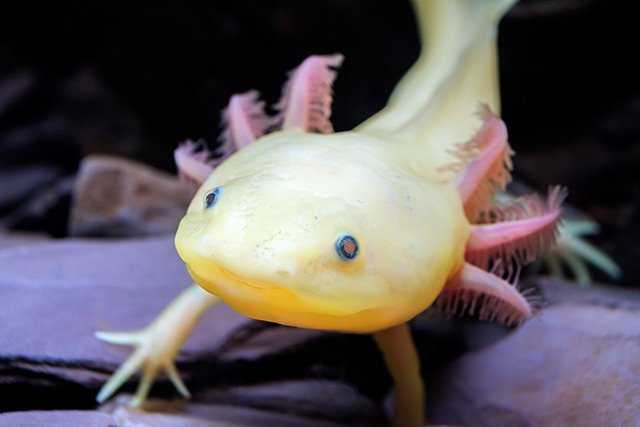
The researchers studied an amphibian native to lakes near Mexico’s City, known as the axolotl or Mexican salamander. The axolotl is an endangered species, and currently has more members bred in captivity than in the wild.
Captive-bred axolotls are often used in biological research because of their remarkable regeneration ability — they can regenerate amputated limbs, as well as parts of their brain and heart, to their original state without scar tissue.
“Humans have very limited capacity for regeneration, while other species like salamanders have the remarkable ability to functionally regenerate limbs, heart tissue and even the spinal cord after injury,” said lead researcher Karen Echeverri, Ph.D., assistant professor in the department of genetics, cell biology and development at the University of Minnesota. “We have discovered that despite this difference in response to injury, these animals share many of the same genes with humans. This knowledge could be used to design new therapeutic targets for treating spinal cord injury or other neurodegenerative diseases.”
Mother Nature’s micronutrient secret: Organic Broccoli Sprout Capsules now available, delivering 280mg of high-density nutrition, including the extraordinary “sulforaphane” and “glucosinolate” nutrients found only in cruciferous healing foods. Every lot laboratory tested. See availability here.
When an axolotl suffers a spinal cord injury, it triggers the rapid proliferation of nearby cells called glial cells which immediately get to work reconnecting the nerves and the injured spinal cord. In humans, the glial cells form scar tissue, which blocks the nerves from reconnecting with each other.
The researchers investigated the molecular mechanisms and found that a particular protein called c-Fos, which affects gene expression, is a key factor in repairing injured nerves in axolotls.
In humans, the c-Fos protein acts in a way that causes cells to undergo reactive gliosis, leading to scar formation. In axolotls, the glial cells respond to regenerate the tissue instead.
“Our approach allows us to identify not just the mechanisms necessary to drive regeneration in salamanders but what is happening differently in humans in reposes to injury,” said Echeverri.
She added that their research can be applied to other types of injuries and regeneration, such as scar-free wound healing and regrowing limbs.
Fun facts about the axolotl
Axolotls look like huge tadpoles, but there’s a reason behind that. Here are some fun facts about this strange amphibian.
- Axolotls are endemic in the lake Xochimilco, near the Mexico City. It is found nowhere else in the world in the wild, but it has been bred in captivity in different laboratories and aquariums.
- Axolotls can grow to up to 12 inches long and weigh up to eight pounds.
- Male and female axolotls look alike, so gender identification can only be performed by experts.
- Most captive-bred axolotls are pinkish-white, while wild axolotls are often black or greenish-brown.
- Unlike its amphibian cousins, axolotls do not undergo metamorphosis, meaning it retains larval characteristics in its adult form. This is called neoteny.
- The frills in an axolotl’s head are its gills. Axolotls also have lungs like other amphibians, but they are known to primarily stay aquatic and never go onto land.
- Axolotls are carnivores. Their diet consists of mollusks, crustaceans, small fish, insect larvae, and smaller or juvenile axolotls.
- Before they were critically endangered, axolotls are a part of the delicacy of Xochimilco natives.
Learn about other interesting biological mechanisms used in modern human treatments at Research.
Sources include:
ScienceDaily
MentalFloss
SoftSchools
